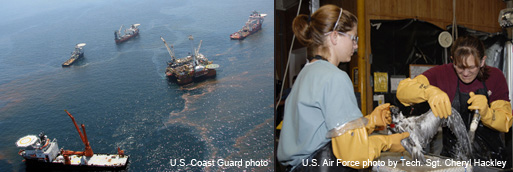
When Solutions Seem Impossible
Key idea: Real-world problems often involve
competing constraints.
Activity: Students read dialogue between two
engineers discussing competing constraints for an oil spill cleanup
project.
Recovery Time
Key idea: Test data are essential when deciding what
is possible and what is impossible.
Activity: Students test how changes in the recovery
rate of oil affect the efficiency of recovery.
Possible versus Impossible
Key idea: Explaining test results involves making a
claim, providing evidence, and giving a reason the evidence supports
the claim.
Activity: Students read field notes from an oil spill
engineer and learn how the engineer explains test data from the Engage
activity.
Simulate and Save
Key idea: Simulations help us understand how
technologies work without going into the field.
Activity: Students use a simulation to explain the
way various oil spill technologies work.
Choosing a Solution
Key idea: Solutions to complex problems often mean
presenting workable choices.
Activity: Students choose a set of oil spill
constraints and then develop a recommended cleanup plan to present to
stakeholders.







 Engage
Linking
Question Explore Linking
Question Explain Linking
Question Elaborate Linking
Question Evaluate
Engage
Linking
Question Explore Linking
Question Explain Linking
Question Elaborate Linking
Question Evaluate