




Designing Environmental Solutions

Yellow
Green
Blue
Red
Magenta
Remove
    Bookmark This Page
    Unbookmark This Page
    Module Overview
    Module Overview
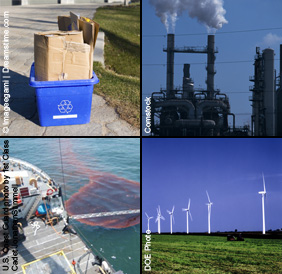
    Figure 1

    Think about the things you do in a typical day.

    • How do you spend your time?
    • What kinds of products do you use?
    • What kinds of activities do you do?

    Have you ever thought about how your choices might affect the natural environment? Everyone does things every day that can have an impact on the environment. Some of these impacts are positive. Some are negative. But everyone has an influence.

    It is not just individuals who influence Earth’s environment. Think about how companies and factories can have an impact on the environment. They, too, can have positive or negative effects.

    Technology can play a big role in what happens to the environment. Interestingly, new technologies have caused some problems within the environment at the same time they have provided some solutions to environmental problems.

    Goals for the Module

    In this module, you will think about environmental problems and solutions. You will learn about garbage and recycling in this chapter. In later chapters, you will learn about air pollution problems and oil spills. In the last chapter, you will have a chance to design an environmental solution of your own. What problems related to the environment do you think you can solve?

    The titles of the chapters are as follows:

      Chapter 1: Garbage In, Garbage Out
      Chapter 2: Air Pollution Solutions
      Chapter 3: Clean Up Your Spills!
      Chapter 4: Taking Action

    Module Overview

    In this module students will learn about environmental issues and how we can use technology to solve some of those issues.

    In the first chapter, “Garbage In, Garbage Out,” students will focus on garbage and on alternative methods of garbage disposal, such as recycling. The second chapter, “Air Pollution Solutions,” helps students learn more about air pollution and its effects. The third chapter, “Clean Up Your Spills!,” focuses on oil spills. Students continue to learn about technology and the process of technology design through each of these chapters. In the final chapter of this module, “Taking Action,” students apply some of their knowledge about technology to design a solution to an environmental issue that concerns them.

    The activities in these chapters require students to work in collaborative teams. Research shows that working in teams helps students see that the teacher is not the sole authority in the classroom. Students are empowered by exchanging information among their peers. Working in teams also allows students to practice teamwork skills. These skills use important science and engineering practices that will prepare them for entering the workforce in the next decade or so. At times, the student materials highlight these teamwork skills, and students are encouraged to reflect on their work in teams.

    Goals for the Module

    By the end of this module, students should

    • be able to describe some of the environmental challenges that humans face
    • explain how technology has helped humans meet environmental challenges
    • understand how ideas such as criteria, constraints, fair tests, and human factors apply to technology that address environmental challenges
    • design and carry out a technology solution to a local environmental issue.