








On your own, do as much as you can on these questions in five minutes. Then work with your partner to finalize your answers. Be sure you both have answers written in your technology notebooks.
-
How does having choices affect
- the solution to a complex problem?
- your ability to come up with a clear-cut answer?
- your attitude when you are allowed options in how to answer questions?
-
What does the term "realistic choice" mean? Explain your answer using specific examples from this activity.
-
Explain the ways in which working in a team
- improved your performance in this activity
- detracted from your performance in this activity.
-
Sketch the curve you think is correct for the graph in figure 3-24 and answer Questions 4a-c. Hint
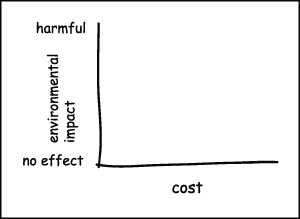 Figure 3-24: Cost versus environmental impact. Does this sketch graph show the correct relationship?
- Are cost and environmental impact competing constraints? Explain.
- Select a point above or below the curve you made. Explain if this point is a desirable or undesirable combination of variables.
- Meet with a team that selected a point on the opposite side of the curve. Take turns explaining your answers to each other.
Answers to Reflect and Connect
Monitor students for about 5 minutes while they answer these questions on their own. Tell them this is like a practice test. The difference is that you will eventually go over each answer before it is graded.
-
How does having choices affect
- the solution to a complex problem?
Answers will vary. Look for a connection between and the ingredients of a complex problem. That is, problems often become complex when the number of options or choices increases. For example, suppose a carpenter needs to install a door. If the door must fit into an existing door jamb, then the choices are restricted. But if the door is for a house that is yet to be designed, then the number of choices is greater, making the problem more complex.
- your attitude when you are allowed options in how to
answer questions?
Answers will vary. If students do not think choice affects their ability to come up with a definitive answer, accept this as long as they justify their answer, preferably with an example. Generally, the more choices inherent in a problem, the less likely it is one will reach a definitive answer. Thus, what seems to be a positive aspect (choice) can lead to results that are more difficult to deal with. This is natural and realistic.
- your attitude when you are allowed options in how to
answer questions?
This answer is subjective. Nonetheless, look for detail in the answers, primarily in the form of concrete examples. Many people feel motivated by having some choices.
- the solution to a complex problem?
- What does the term "realistic choice" mean? Explain
your answer using specific examples from this activity.
Realistic choice most likely refers to an option that is possible, economical, and acceptable to all stakeholders. Of course, combining all three elements is sometimes very difficult. Any one feature can produce a "deal breaker."
- Explain the ways in which working in a team
- improved your performance in this activity
Answers will vary. If a student says that working in a team did not help (quite possible), then take time to think carefully about team composition and whether the task is best accomplished through teamwork. Generally, complex problems are best solved by teams—many minds make light work. Practice and simple skills are not tasks that lend themselves to teamwork.
- detracted from your performance in this activity.
Answers will vary.
- improved your performance in this activity
- Sketch the curve you think is correct for the graph
below and answer Questions 4a–c.
- Are cost and environmental impact competing
constraints? Explain.
A reasonable graph would show some type of inverse relationship. Thus, any line or curve that starts in the upper left and proceeds to the lower right of these axes would be a good starting point. That is, as cost increases, harmful environmental impact decreases.
If students show an inverse relationship, then cost and environmental impact are competing constraints, because increasing one drives possible solutions to the other in an opposite direction.
- Select a point above or below the curve you made.
Explain if this point is a desirable or undesirable
combination of variables.
Above the curve: These points show costs that produce lots of environmental harm. The prospect of spending a lot of money that still results in a lot of environmental harm is undesirable.
Below the curve: These points show low or no environmental harm. If this can be achieved for small amounts of money, that is desirable.
- Meet with a team that selected a point on the
opposite side of the curve. Take turns explaining your
answers to each other.
Monitor that teams match up and actually discuss their positions. If no teams picked points below the curve, then you can play that role for the entire class.
- Are cost and environmental impact competing
constraints? Explain.