




Work by yourself to answer the following questions in your technology notebook.
-
Why do you think it is a good idea for you to work on a solution to a local issue rather than an issue in another part of the country?
-
How did brainstorming help you come up with the final solution you chose to work on?
-
Your team chose one solution.
- What characteristics made that solution the best choice for your problem?
- Are there particular people who would like the solution or not like the solution? Why? Hint
-
In what step did you and your teammates share responsibility? There may be more than one, but choose the one that showed your best work at this teamwork skill. How did you share responsibility in that step?
-
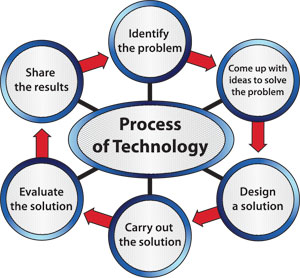
Include a copy of the Process of Technology Design graphic in your technology notebook. You first used this graphic in the “Doing Technology” chapter.
- Draw an X next to any phase that you did during this activity.
- Write the word “explore” next to any X that you drew to show that you did the phase during the Explore activity.
- Describe how you were doing that phase in the activity.
- Mark this page with a sticky note or paper clip. You will come back to the graphic later in the chapter. Hint
Answers to Reflect and Connect
Give students time to work on these questions individually. They should write their answers in their technology notebooks. You may wish to discuss some or all of the questions once students have completed their individual work.
-
Why do you think it is a good idea for you to work on a solution to a local issue rather than an issue in another country?
Students may have different ideas about this, but expect them to come up with answers such as caring more about something in their own area, being able to see the impact or results when it is close by, or knowing more about what is happening in their neighborhood.
-
How did brainstorming help you come up with the final solution you chose to work on?
Students should understand that by brainstorming, they were able to think of many possibilities, then narrow them down to one idea to pursue. Without brainstorming, they may not have had enough choices and may not have come up with the “best” solution to design.
-
Your team chose one solution.
- What characteristics made that solution the best choice for your problem?
- Are there particular people who would like the solution or not like the solution? Why?
Student answers will vary for this question. Make sure that they are thinking of reasonable characteristics for their solution. If students know about constraints and criteria, they might list some of those in their answer. Students might also list why other ideas did not work, leading them to narrow down their list to the final choice.
-
In what step did you and your teammates share responsibility? There may be more than one, but choose the one that showed your best work at this teamwork skill. How did you share responsibility in that step?
Students should recognize that they were sharing responsibility in Step 6 because they all found different information to contribute about the issue. If they list other steps, make sure they justify their ideas.
-
Tape or glue a copy of the Process of Technology Design graphic in your technology notebook. You first used this graphic in the "Doing Technology" chapter.
- Draw an X next to any phase that you did during this activity.
- Write the word “explore” next to any X that you drew to show that you did the phase during the Explore activity.
- Describe how you were doing that phase in the activity.
- Mark this page with a sticky note or paper clip. You will come back to the graphic later in the chapter.
Students identified the problem and came up with ideas to solve the problem in this activity. They identified the problem when they researched the different local issues and chose one on which to focus. They came up with ideas to solve the problem during their brainstorming session. Students should mark this page so they can find it easily because they will repeat this question during the Explain and Elaborate activities.