








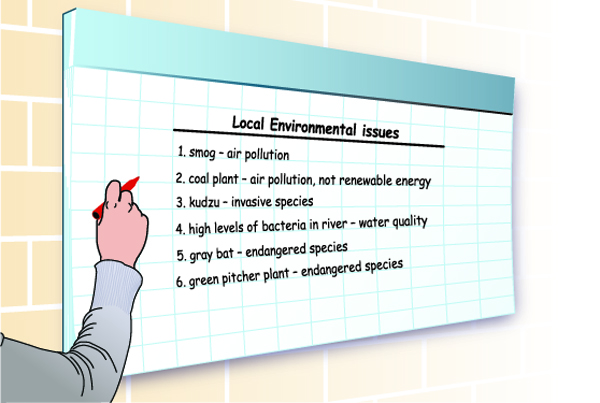
Were you surprised by the number of local issues that your class found during the Engage activity? Today, there are many concerns about the environment in all places. (See figure 4-4.) Although this may seem discouraging, the good news is that you can do something about the concerns! Think back to the finalists for the Siemens We Can Change the World Challenge. The students on those teams were able to have a positive impact on an environmental issue nearby. As you work through this chapter, your team is going to design a technology solution to help address an issue where you live. You will start the process of design in this activity by choosing a local issue. Then you and your team will work to learn more about the issue. You will practice the teamwork skill of sharing responsibility as you work. Materials

-
Get a copy of Questions Related to Local Issues. Read through the questions and examples on the master. Hint
-
Use newspapers, the Internet, or other resources to find examples of environmental concerns near where you live. Make a list of as many local issues as you can. Use the Questions Related to Local Issues master to help you find issues. Hint
-
Add your examples of local issues to a class list, like the one in figure 4-5.
-
In your technology notebook, list the 3 examples that are most important to you.
-
Join with 2 other students to form a team. Share the examples that were most important to you. As a team, come to a consensus about the problem you will try to address as you complete the rest of the chapter. Hint
-
Work by yourself to find information on the local issue your team will be addressing. You should collect at least 2 pieces of information about the issue. Try to find information that helps you understand the issue and what people are doing about it. If different people have different ideas, be sure to note who the people are and what their ideas are. Also, write down where you found the information so you can create a list of references later. Hint
-
Share the information you found with your team. Make a list in your notebook that includes important facts about your issue. This should include the information your teammates found as well as yours.
-
With your team, brainstorm about a technology solution your team could design to help address the environmental issue. Make a list on a large piece of paper of all the solutions you can think of to address the problem. You will have 10 minutes to brainstorm. Hint
-
Work with your team to decide on the solution you will design by following Steps a–d.
- Cross off any solution that you do not think would work.
- Discuss each solution that is left on the list. If you decide a solution is not the best one to address the problem, cross it off.
- Once you have narrowed down the list to only 2 or 3 solutions, work to come to a consensus about the one you will design.
- Draw a circle around the solution you chose.
Activity Overview
In this activity, students will narrow down their ideas about the local issue for which they would like to create a solution. They will work to find examples of local issues in their area. They will then join with a team and decide on a local issue that they would like to address. The teams will collect information about the issue, then brainstorm ideas about solutions they could create.
Before You Teach
Materials
For each team of 3 students:
- local newspapers or other news resources (optional)
- computer(s) with Internet access (see Advance Preparation)
- 3 copies of Master 4-1, Questions Related to Local Issues
- markers
- butcher paper
- 3 copies of graphic from Master 4-2, Process of Technology Design Graphic (see Advance Preparation)
- 3 sticky notes or paper clips
Advance Preparation
Make copies of Master 4-1, Questions Related to Local Issues. Each student will need a copy of this master.
Make copies of Master 4-2, Process of Technology Design Graphic. The master has four images of the graphic. Each student needs only one copy of the graphic, so make an appropriate number of copies of the master, then cut apart the graphics.
Decide how you will have students do research. If you choose to allow them to do Internet-based research, make reservations for the computer lab or computer cart, if necessary. Ideally, each student should have access to a computer. If that is not possible, allow teams to work together on one computer, but ensure that each person is contributing to the work.
If you would prefer to have students conduct print-based research, gather newspapers and other news resources. These should include stories on a variety of local environmental concerns. Try to find articles that relate to the list of concerns in Step 5 of the Engage activity and the Questions Related to Local Issues master. In Step 6 of this activity, students are instructed to find at least two pieces of information about the local issue, so gather enough articles to allow the three team members working on an issue to find plenty of information.
As You Teach
Outcomes and Indicators of Success
By the end of this activity, students will
-
become familiar with local environmental issues.
They will show their familiarity with the issues by
- contributing to a class list about local issues
- researching and sharing information about one local environmental issue
- brainstorming possible solutions to address the issue.
-
practice the teamwork skill of sharing responsibility.
They will demonstrate their skill by
- contributing to the team information on a local issue
- reflecting on when and how they shared responsibility.
-
demonstrate understanding of some phases of the process of technology design.
They will demonstrate their understanding by
- choosing which phases they worked on during the activity
- describing how they were doing that phase during the activity.
Strategies
Getting Started
Remind students about the local issues that students addressed in the stories about the Siemens We Can Change the World Challenge finalists. Ask students if they were surprised about the number of local issues that they saw in the stories. You might also ask if they were surprised by the number of environmental concerns the class discussed during the Engage activity. Point students to the Chapter Organizer and ask them what the key idea will be for this activity.
Process and Procedure
Distribute copies of the Questions Related to Local Issues master. Allow students time to read through the questions and examples that will help them find local environmental issues. You may want to have them take turns reading with other members of their team.
-
Direct students on how to find information about the environmental concerns in your area. If you have print-based resources, you may want to spread them around the room and ask students to review as many as possible. If you are having students conduct Internet-based research, do a practice search with them.
Although students may be familiar with Internet-based research, they may need to be reminded that they should be finding issues in your local area, so they should not simply search for “endangered species,” but rather should add the name of your city, county, or state to their search. How to Conduct an Effective Web Search may be useful to the students, so you might ask them to read that as well. The teacher version of How to Conduct an Effective Web Search is a helpful resource, also. Emphasize to students that their goal is to find as many local issues as they can, so they should continue looking until you tell them that time is up.
Generate a class list of local environmental issues with your students. Make sure the list is in a place that is visible for the entire class. Ask each team to contribute at least 2 or 3 ideas to the list so that they have plenty to choose from when they select the issue they will work on for the rest of the chapter.
Students should individually write down the issues that are most important to them. Be sure that the class is quiet during this time.
-
Direct the class on how to form teams. You might want to form teams based on the issues that students found most important so that all students will be able to work on an issue they find relevant. Otherwise, have students join with 2 other students and discuss each teammate’s ideas on the most important issue. They should come to a consensus on the issue they will address.
Remind students that they will continue working on this issue for the rest of the chapter, so they should be sure to choose a topic that interests them. Consider whether you would like each team to address a different local issue. Because the focus is developing a technology solution rather than simply finding out about the issue, it is probably acceptable for more than one team to work on the same issue as long as they come up with different solutions. However, you should limit the number of teams that work on any one issue.
Students work to find at least 2 pieces of information on the issue that the team will be addressing. Ideally, have each student work on a computer individually. If this is not possible, take turns on the computer or provide an option for students to work at home if they have access to a computer. If your students do not have much experience with creating bibliographies or reference lists, be sure they know what information they will need to write down about their resources and the format in which to write it before they begin their research.
Hint The hint suggests that students refer to How To Cite References and Avoid Plagiarism. The teacher version of How to Cite References and Avoid Plagiarism provides additional support on this topic.
Give teams time to share what they found about their issue. Each student should write down important information about the issue in his or her technology notebook.
Provide each team with butcher paper and markers. Take a few minutes to discuss brainstorming with students. Explain that one person in the group should record the ideas. Encourage everyone to listen to the other ideas offered without criticism. Suggest that each person have a turn at offering an idea before anyone in the group offers a second idea. Have the group decide whether one person will explain the group's ideas to the class, or whether each person will explain their own idea to the class. Emphasize that this is not a time to evaluate ideas but rather to try to get as many ideas as possible. Give students 10 minutes to brainstorm possible solutions to address the issue. Tell them that they should keep listing ideas until the 10 minutes is up.
Mention to students that in the next activity they will design a model of their solution to represent the actual idea they are pursuing. Students should use the process listed in Step 9 to narrow down their ideas. By the end of their discussion, the team should have one idea circled that they choose to pursue.