

Work with your team to answer the following questions. Each team member should write answers in his or her own technology notebook.
-
In this activity, you built a model for your solution.
- Think about your design. Why do you think it was useful for you to build a model instead of the actual design?
- What are the strengths of your model? List at least two ways it does a good job of representing your solution.
- What are the limitations of your model? List at least two ways that it does not represent your solution very well.
- Engineers build and use models in their work. How do you think models improve their work?
-
The teamwork skill in this chapter is sharing responsibility.
- Describe one way each team member shared responsibility. Include the number of each step in which you did any of the work you list.
- List two ways in which sharing responsibility helped you complete this activity.
-
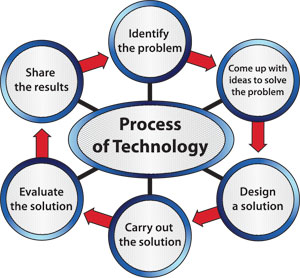
Look back at the Process of Technology Design graphic that you put in your notebook. You should have marked the page with a sticky note or paper clip.
- Draw an X next to any phase that you did during this activity.
- Write the word “explain” next to any X that you drew to show you completed it during the Explain activity.
- Describe how you were doing that phase in this Explain activity.
Answers to Reflect and Connect
Students should work in their teams to answer the questions. Tell students that each of them must have the answers in his or her technology notebook. Discuss some or all of the questions once students have had a chance to work.
-
In this activity, you built a model for your solution.
-
Think about your design. Why do you think it was useful for you to build a model instead of the actual design?
Students should realize that they may have come up with a solution that is too large, complicated, or expensive to build in the classroom. In cases like this, a model can help them visualize and test the solution.
-
What are the strengths of your model? List at least two ways it does a good job of representing your solution.
Student answers will vary, depending on the solution they chose and the model.
-
What are the limitations of your model? List at least two ways that it does not represent your solution very well.
Student answers will vary. Some examples might be that it is not to scale or that it is not the size it would need to be to address the environmental issue. Students might also say it does not use the materials that would be used to build the real solution.
-
Engineers build and use models in their work. How do you think models improve their work?
This question is meant to be more general than 1a. Students should realize that models can help engineers because they might be able to test out their idea before building the real solution. This could be especially valuable if the solution is expensive or uses parts that are not readily available.
-
-
The teamwork skill in this chapter is sharing responsibility.
-
Describe what each team member did to share responsibility. Include the number of each step in which you did any of the work you list.
Students should have shared responsibility in many of the steps in this activity, such as deciding on materials and building the model.
-
List two ways in which sharing responsibility helped you complete this activity.
Sharing responsibility was probably important to many teams. Depending on the complexity of the solution, they may not have been able to build the model without having extra pairs of hands. Sharing responsibility also allows more than one mind to work on a problem, so this teamwork skill may have helped in coming up with the design or in deciding on materials.
-
-
Look back at the Process of Technology Design graphic that you put in your notebook. You should have marked the page with a sticky note or paper clip.
- Draw an X next to any phase that you did during this activity.
- Write the word “explain” next to any X that you drew to show you completed it during the Explain activity.
-
Describe how you were doing that phase in the activity.
Students were designing the solution and carrying out the solution in this activity. If students discovered their solution may not work, they might also have gone back to coming up with ideas to solve the problem. The first part of the activity was dedicated to design, with students discussing the details of the design and creating a blueprint. As they built their model, they were carrying out their solution. If some students feel that just building a model was not actually carrying out the solution, reinforce to them that a model can be a valid way of testing the solution. To really make sure the solution works, they would need to complete these phases of the process of technology design again later with the real solution. Again, this emphasizes that the process is not linear, but rather allows students to flow between the different phases and repeat them as necessary.