



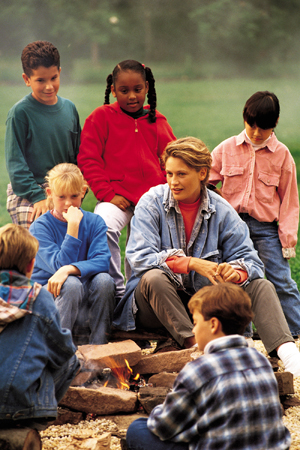
Siemens is a global engineering company. It has locations at 1,640 sites around the world. The company focuses on creating technologies in the areas of health care, energy, and industry. Each year, Siemens gives students a chance to make a positive difference in the environment with the Siemens We Can Change the World Challenge. As part of the challenge, teams identify local environmental issues that are of concern. They then work to create improvements for one of these problems in their local area. The challenge is open to students in kindergarten through twelfth grade like those in figure 4-2. It includes a challenge just for middle school students. As you work through this chapter, you will learn more about the challenge. By the end of the chapter, your team will have created its own application for the challenge. Materials
-
In the first 3 chapters of this module, you learned about garbage, oil spills, and air pollution. Make a list of any other environmental issues that you can think of. Hint
-
Go to the list of middle school state finalists for the 2011 Siemens We Can Change the World Challenge. Pick one story to read. As you read, make a list of the following.
- What state was the team in?
- What environmental issue was the team concerned about?
- What did the team do address the issue? Hint
-
Find the story about the Florida team. Answer the questions listed in Step 2 related to the team.
-
Describe the technology the Florida team created to solve the problem. How does their solution fit the definition of a technology?
-
Participate in a class discussion about other environmental concerns. Share what you know about environmental concerns during the discussion. Some examples of environmental concerns are
- Garbage
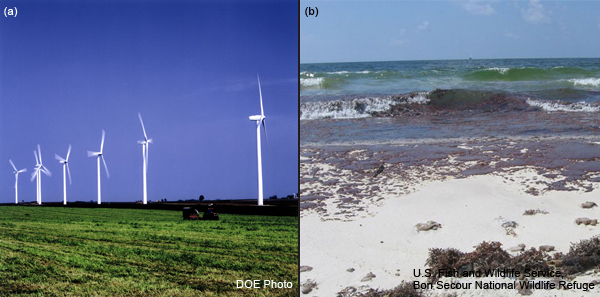
- Oil spills (See figure 4-3b.)
- Air pollution
- Energy usage (See figure 4-3a.)
- Endangered species
- Invasive species
- Toxic chemicals
- Climate change
- Erosion.
Activity Overview
In this activity, students read about some of the finalists for the Siemens We Can Change the World Challenge. The middle school teams in this challenge have worked to address a local environmental issue. Students also participate in a discussion about what they already know about environmental concerns.
Before You Teach
Materials
For each student:
- computer with Internet access
Advance Preparation
If necessary, reserve the computer cart or computer lab. Students can work in pairs for this activity if there are not enough computers for each student.
As You Teach
Outcomes and Indicators of Success
By the end of this activity, students will
reveal their current ideas on environmental concerns.
- participating in a class discussion on environmental concerns
- sharing which environmental issue is most important to them and why.
show an interest in the relationship between environmental concerns and technology.
consider how they can make a difference in environmental concerns.
- describing what finalists for the Siemens Challenge did to address an environmental concern
- explaining what they found most interesting about the finalists’ stories.
They will show their ideas by
They will show their interest by explaining how the solutions that finalists developed for the Siemens We Can Change the World Challenge are considered technologies.
They will show their understanding by
Strategies
Getting Started
Begin by asking students to read through the chapter organizer. You might ask them what sounds most interesting about this chapter or what they think they will enjoy most. Then read the introduction to the Engage activity. Hold a brief discussion with students about the challenge and what students think about it. Try to generate excitement for the challenge. Some students will likely want to enter the challenge, so encourage them to keep that in mind as they go through the rest of the chapter. During the Evaluate activity, they will be completing an application to the challenge, though they are not required to submit it.
Process and Procedure
As students work through this activity, they will be sharing what they already know about environmental concerns. In the first 3 chapters of this module, they focused on 3 different environmental concerns—garbage, air pollution, and oil spills. Students should list any other environmental concerns they have heard about. Expect that many students will list the rain forest and endangered animals, as these concerns are familiar to many people. They might also list climate change.
-
The purpose of this step is to help students understand that people their age are making a difference in their own communities related to environmental issues. Students should go to the Siemens We Can Change the World Challenge website to read the state finalists’ stories.
If you do not have enough computers available, students may work in pairs for Steps 2 and 3. Allow students some time to look through the different stories. Tell them to pick the story that interests them the most and answer the questions listed in the bullets. Ask them to pick a team other than the one from Florida, because they will examine that story in the next step.
If students finish early, they should read additional stories, as noted in the hint. The reading level of some of the stories is slightly high for middle school students. If you do not feel like your students can effectively read the stories and glean the necessary information, give them a few minutes to at least get the basic idea of the stories. Then poll the class to find out the stories that most interested them. Go through a couple of the stories as a class. The students should still answer the questions listed in Step 2.
Students should find the story about the Florida team and answer the questions. Again, if you think the reading level may be too difficult for your students, go through the story as a class. For your information, the Florida team is singled out in these materials because they created a technology to solve the problem in their community. Many of the other teams did awareness campaigns, which are also valuable ways to make a difference in the community. However, because this chapter focuses on designing a technology solution to an environmental issue, the Florida team is highlighted to help students begin thinking about their own work in this chapter.
If students have problems remembering the definition of a technology, refer them back to their notebooks for the “Doing Technology” chapter. They should remember that a technology is anything that helps people solve a problem. They should be able to explain that the filter created by the Florida team helped to solve the problem of excess organic nutrients in the water.
-
Lead a discussion about the other environmental concerns that students know about. They should have some ideas from the stories of the finalists in the Siemens Challenge. A list of general concerns is provided. Ask students what they know about each of the concerns and if they think it affects their area. You might also start this step as a team discussion among 4 students, then expand it to a class discussion. This will help more students be involved in the discussion.
Once students have completed the Reflect and Connect questions, begin the Explore activity, even if it is the middle of a period. This will help reduce the number of days you need the computer lab or cart.