




Answer the following questions on your own in your technology notebook.
-
You used radishes as a model for what happens in the environment. Complete the analogy map in figure 2-10 to help you think about the parts of this model.
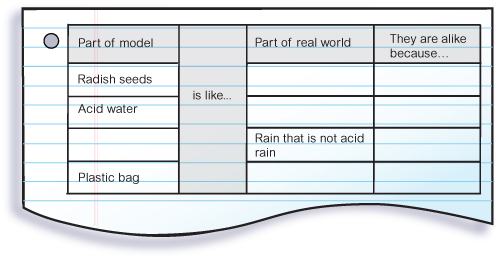 Figure 2-10: An analogy map. Complete the blank spaces in this analogy map to help you think about how your model represents the real world.
 -
What were the strengths of the model? What were the limitations of the model? Explain your answers.
-
In this activity, you looked up the Air Quality Index (AQI) for your area.
- Is the AQI an example of a technology?
- How do you think the people who created the AQI might have used the process of technology design? (See figure 2-11.) What might they have done at each step of the process?
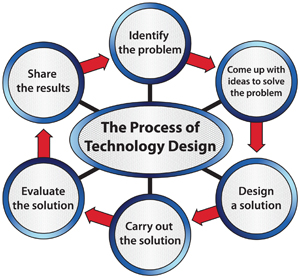 Figure 2-11: Process of Technology Design.
 -
How has air quality had an impact where you live? Hint
Answers to Reflect and Connect
Allow students time to answer these questions. Once they have had time to complete the questions, you may want to hold a class discussion on some or all of them.
-
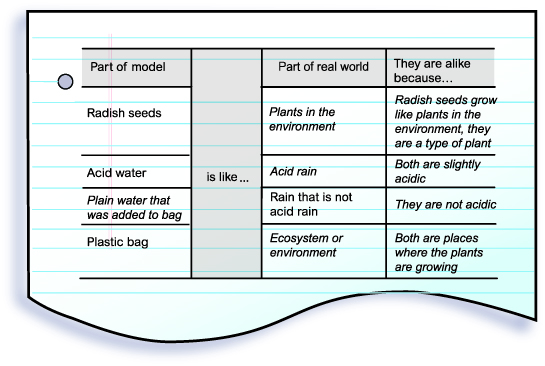
You used radishes as a model for what happens in the environment. Complete the analogy map in figure T2-1 to help you think about the parts of this model.
-
What were the strengths of the model? What were the limitations of the model? Explain your answers.
When students use models, they should be asked to evaluate those models. Students should recognize that strengths included that they were able to see plants growing, they could see the effects of the acid water, and they could quickly see results. Limitations included that only one kind of plant was used, the water did not fall on the plant the same way acid rain would, and the environment was small compared to a forest or other ecosystem. Some students may go further and list that the amount of acid water that was added may not really represent the amount of acid rain that would fall on the plants or that the acid water might not have been the same acidity. There are other reasonable answers as well.
-
In this activity, you looked up the Air Quality Index (AQI) for your area.
-
Is the AQI an example of a technology?
The AQI could be considered a technology because it addresses a problem of how people know whether to be concerned about air quality.
-
How do you think the people who created the AQI might have used the process of technology design? What might they have done at each step of the process?
To develop the AQI, the designers needed to identify the problem (people needed information about air quality). They would also have needed to know what data are available and how people could get this information. They then designed a website that anyone can access. The steps related to evaluating the solution and sharing the results are less obvious.
-
-
How has air quality had an impact where you live?
Students could look in their local papers, spend time watching local weather forecasts, or look for examples online. Depending on where you live, these types of warnings can be more or less frequent.