





As you learned in the Explain activity, Why Is Air Pollution a Problem?, air pollution can cause problems for human health. It can also damage the environment. Some of the pollutants in the air come from natural sources, including soil, sand, ash from volcanic eruptions, and soot from forest fires. Other pollutants are caused by human activities, including driving motor vehicles, operating factories, and generating electricity.
Many technologies have been developed to help reduce pollution in the air. Some of these technologies have been in use for a few decades and others are fairly recent (See figure 2-12.) As you have found with other technologies, these technologies for reducing air pollution are not perfect. All technologies have advantages and disadvantages.
In this Elaborate activity, Technologies to Reduce Air Pollution, you will learn how decisions about technology involve thinking about costs and benefits. You will then think about costs and benefits for different technologies related to improving air quality.
-
Look at your answer to Reflect and Connect question 2 from the Engage activity. If you have any new ideas now, add them to that list. Hint
-
Choose one of the items on your list. Can you think of reasons why you and your family would want to use that item? Are there disadvantages to using that item? Record your ideas in your technology notebook. Hint
-
People have different reasons for making decisions about things. Read Benefits and Costs to learn more about how people make decisions. As you read, think about whether the advantages and disadvantages you listed in Step 2 are costs or benefits.
-
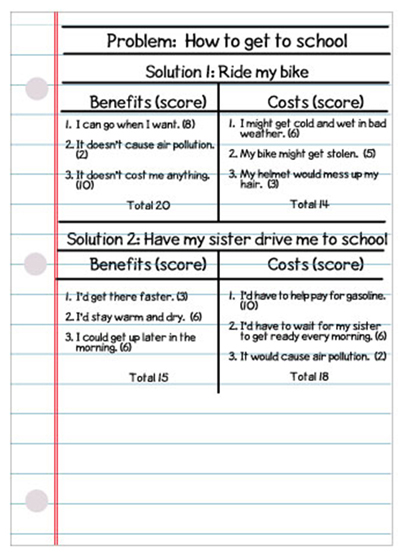
Figure 2-13 shows how a student named Marie rated some of the possible benefits and costs for two solutions to the problem of getting to school. According to Marie’s rating system, a 10 means that she feels very strongly about a particular cost or benefit. A score of 1 means that she cares very little about that particular cost or benefit. Based on the totals for each set of benefits and costs, which solution do you think Marie will choose?
-
Make your own chart that shows the costs and benefits of the different ways that you might get to school.
- Which way would you actually choose?
- Imagine that you placed a high value on reducing air pollution. Would your ratings for costs and benefits be the same or different from what you decided in Step 5a?
- Can you think of a situation (other than getting to school) where you might make a decision in which the costs seem to outweigh the benefits? Explain your answer.
-
Many technologies have been developed to help reduce air pollution. As with all technologies, however, each has benefits and costs. Join with 3 other students. Pick a technology to become an expert on. You can choose one of the following:
- catalytic converter—a technology that reduces the amount of pollutants added to the air by car and truck exhaust
- electrostatic precipitator—a technology that reduces the amount of pollutants added to the air by factories
- carbon monoxide detector—a technology that alerts people to the amount of carbon monoxide in the air (remember that carbon monoxide is a pollutant)
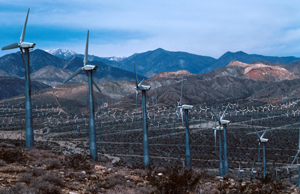
- wind power—a technology that can produce energy and does not produce air pollutants.
-
Draw a 2-column table in your technology notebook. Label the columns “costs” and “benefits.” Read about the technology you chose. As you read, complete the table. Also underline information that will be important to share with your teammates. Hint
-
Share information about your technology with your teammates. Be sure to include the problem the technology was designed to solve. Also describe its costs and benefits. Hint
Benefits and Costs
Have you ever wondered why there are many different models of cars? Why isn’t one style of car enough? After all, the problem that this technology was designed to solve is moving us from one place to another—and any car could do that. But not all cars are the same. People decide what car to buy based on their needs. In fact, every technology solution involves both benefits and costs. The benefits are the advantages, or “pros,” of a particular solution. The costs are the disadvantages, or “cons.” The best solution for a problem is the one that gives you the most acceptable costs along with the most desirable benefits.
You may think that a decision is acceptable or desirable. Someone else may not see that decision as okay. For example, every student must solve the problem of how to get to school. For some students, the best solution is to take the bus. One benefit of this solution is that you get to school inexpensively. Another benefit is not having to worry about who will take you to school. The costs of this solution include having to get up early to catch the bus and having to wait at the bus stop. For some students, these costs are too high for the benefits. They would rather have their parents drive them to school. Then they can sleep later and they don’t have to stand outside in bad weather.
Your solution to the problem of getting to school also involves a decision that can relate to air quality and air pollution. If you solve the problem by riding in a bus or car, you use a motor vehicle that adds to air pollution. If you solve the problem by walking or riding a bicycle, it may contribute less to air pollution and be less expensive. On the other hand, it may take longer and it may not be as safe.
Some issues, including air pollution, usually have different decisions to think about. Each possible solution has different benefits and costs. Sometimes it is not easy to see which solution is the “best.” The best solution has the most acceptable costs and the greatest benefits. To help evaluate different solutions, you can use a method of rating each benefit and each cost. After you have rated them, you could total the scores for the benefits and the costs. Comparing these totals for different solutions can help you determine which solution is the best one at a given time.
Activity Overview
In the previous lessons, students learned what air pollution is and gained an appreciation of the consequences of air pollution. In this Elaborate activity, Technologies to Reduce Air Pollution, students will learn how decisions about technology involve benefits and costs. They will then practice identifying costs and benefits while learning about a variety of technologies that have been developed to monitor air quality or reduce air pollution.
Before You Teach
Materials
For each team of 4 students:
- 1 copy of Master 2-3, Technologies Related to Air Pollution
Advance Preparation
Make copies of Master 2-3, Technologies Related to Air Pollution. This master has all 4 readings, so each team will need only 1 copy.
As You Teach
Outcomes and Indicators of Success
By the end of this activity, students will
-
understand that all technology involves benefits and costs.
They will demonstrate their understanding by
- analyzing an example of benefits and costs
- developing their own analysis of benefits and costs related to a situation that they might experience in their own lives
- identifying costs and benefits related to technologies designed to monitor air quality or reduce air pollution.
-
recognize that a variety of technologies have been designed to improve air quality.
They will demonstrate this recognition by
- working with their teammates to discuss a variety of air pollution technologies
- comparing different technologies to determine that different technologies take different approaches to improving air quality.
Strategies
Getting Started
Begin by going over the Chapter Organizer again with students. They should read the key ideas of the activities and the linking questions. Have them read the introduction to the Elaborate activity before beginning the activity. Ask students if they can think of any technologies that have been developed to address air pollution. Hold a brief class discussion on the question.
Process and Procedure
-
Remind students to set up their technology notebooks if they have not already done so. Students should review the answers they wrote to a question in the Engage activity. That question asked them to list any technologies that they or their families use to improve the air in their homes. Students may have had additional ideas since that time and should add new ideas to their list.
-
Students should choose one item on their list to think about further. They should now think about why their family uses that item and if there are any disadvantages to that item’s use. This helps turn students’ thinking to the advantages and disadvantages of technology, an idea that is central to this lesson.
-
Allow time for students to complete the reading, Benefits and Costs.
-
Make sure students understand the figure and what they should be doing. Marie’s first option for a solution was to ride her bike to school. Her score in the benefit column was 20 and her score in the cost column was 14. Therefore, she saw more benefit to that option than cost. Her second option for a solution was to have her sister drive her to school. She had a total score of 15 for benefits and 18 for costs for that option. Therefore, the costs were higher than the benefits for that option. Based on the score, it is likely that Marie chose solution 1, riding her bike to school.
-
- Students should make their own chart about the costs and benefits of ways of getting to school. They may base their chart on Marie’s; however, if they have other ideas on how to make the chart, they should feel free to explore them. Students’ charts will differ based on their personal situations. You would expect that the decision they make would match the scores assigned to the different costs and benefits.
- If reducing air pollution was highly valued, students might reach different conclusions than when they did their charts in Step 5a.
- In Step 5c, students are asked to think about a situation in which they might make a decision even if the costs seemed to outweigh the benefits. Usually, you would expect people to make a decision for which they see more benefits than costs. However, there could be times when it would appear that the costs are very high. For example, someone could potentially do something that would seem to be very costly for them if it provided a very great benefit to someone else that they care about. However, this raises the question about whether the person has accurately evaluated the benefit that they are receiving from helping someone else. Some students may not be able to think of a situation.
-
In this activity, students should work in teams of 4. Have them join with their team, then choose a reading. A brief description of each technology is provided. Make sure that each person on a team chooses a different technology to read about.
-
As students draw the 2-column table in their technology notebooks, pass out the copies of Master 2-3, Technologies Related to Air Pollution. Once they have completed their table, they may begin reading. They should be prepared to share information with their teammates. As they read, circulate around the room to make sure that they are completing their tables and underlining important information.
-
Give teams time to share information about the technology with their teammates. As they listen, they should make notes about each technology. You may want to reinforce this step by holding a class discussion after students have completed their team discussions. In the class discussion, go over each technology, why it was designed, and the costs and benefits.