





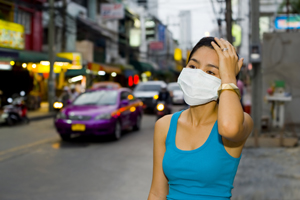
Have you ever listened to a weather forecast when warnings have been given about the air quality? Sometimes, the air pollution can be high in an area. When this happens, officials will warn people who have asthma or other breathing problems to stay indoors. You may hear recommendations to avoid doing heavy activity outside if the air quality is bad.
A few years ago, the Olympics were held in China. Before the Olympic events began, people were worried about the air pollution in Beijing. Some people even decided to wear masks. (See figure 2-4.) This helped to reduce the amount of pollution they were breathing in when they were outside. People disagreed about whether masks were needed—or even a good idea. Even so, the disagreements caused people to think about how air pollution affects humans.
In this Explain activity, Why Is Air Pollution a Problem?, you will learn about the Air Quality Index, a rating system that indicates how different levels of air pollution can affect people’s health. In addition, you will conduct an investigation to model how one type of pollution, acid rain, affects the ability of seeds to sprout. Materials
-
Write the following focus questions in your technology notebook and draw a box around them. Answer the questions with your best ideas.
- What problems are caused by air pollution?
- Why should people be concerned about air pollution? Hint
-
Read the Need to Know: Air Quality Index section. This information will help you during the next steps of this activity.
- ground-level “bad” ozone
- particle pollution
- carbon monoxide
- sulfur dioxide.
-
Look up today’s AQI value for your area. Follow your teacher’s instructions for finding this information online.
-
Use the map of the United States and the AQI values to complete Steps 4a–c.
- Write your observations about the map and air quality in your technology notebook.
- What areas of the country, if any, have concerns with air quality?
- Click on your state. What observations can you make about your area?
-
You have learned that one of the reasons people worry about air pollution is because of how it affects human health. How do you think air pollution affects plants and animals?
-
Acid rain is the result of air pollution. Nitrogen oxides and sulfur dioxide react with water and oxygen in the air. This forms weak acids that fall as rain. How do you think acid rain would affect the ability of seeds to sprout? Write a prediction in your technology notebook.
-
Join with 2 classmates to form a team. Get the materials you will need for the investigation.
-
Follow the Acid Rain and Radishes Protocol to set up your investigation.
- Use the permanent marker to label 1 plastic bag “water.” Label the second bag “acid water.” Write the first names of all team members on each bag. Make sure you write the labels and the names near the top of each bag. That way, the writing will not interfere with the observations you will make over the next few days.
- Fold the paper towels so they fit inside the plastic bags. Put 1 paper towel in each plastic bag.
- Measure 10 mL of water. Pour it carefully into the “water” bag.
- Measure 10 mL of acid water. Pour it into the bag labeled “acid water.”
- Carefully place 10 radish seeds into each bag. Spread the seeds out so that you will be able to see if each seed sprouts. Seal the bags and place them as your teacher instructs.
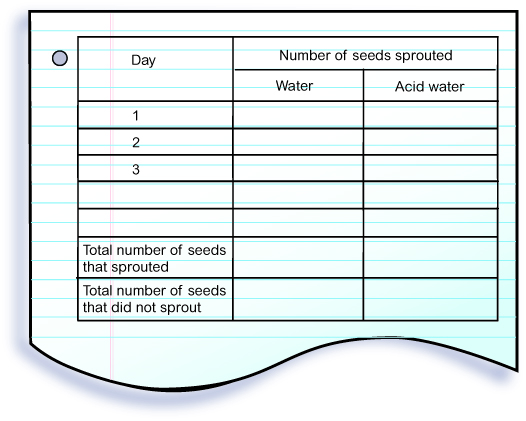
- Draw a table in your technology notebook that looks like the one in figure 2-7. You will use this table to record the results of your investigation.
- On the day after you set up your investigation, work with your team members to see what has happened to the seeds. Count the number of seeds that have sprouted in each bag. Record your results in the results table for day 1. Hint
- For the next few days, continue to look at your seeds each day. Add the data to your results table.
- In your technology notebook, write a sentence that summarizes the results of your investigation. Compare your results with the prediction that you had made before beginning the investigation. Hint
- Read the optional Sidebar to find out more about the effects of air pollution. Sidebar
Need to Know: Air Quality Index
The Air Quality Index (AQI) is a tool that helps people know about the air pollution in their area each day. The AQI is based on four of the six common air pollutants:
The AQI scores air quality on a scale that goes from 0 to 500. The higher the AQI value, the higher the level of air pollution. Maybe you have heard a weather forecast where the person has made comments about air quality. Maybe he or she said, “It’s a code red day for ozone.” You might have heard, “Particle pollution levels are in the unhealthy range today. People with some health conditions should stay indoors.” Maybe the news announced, “The local air quality is unhealthy today.” People can use the AQI to make decisions in their everyday lives. For example, people with lung disease might find out the AQI for the day. They might hear that the AQI value is high or that particle pollution is high. If they hear these statements, they may want to stay indoors that day. This would help them breathe in fewer particles that might lead to lung problems.
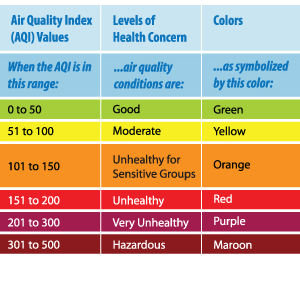
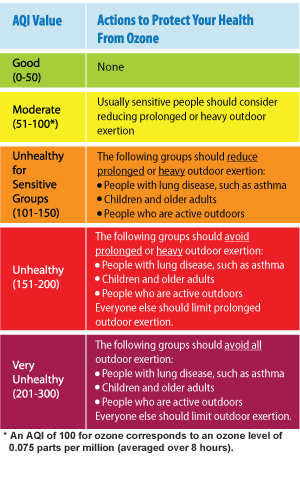
The AQI provides more than just a number. The AQI also uses colors to indicate how the air quality may affect people’s health (figure 2-5). Green indicates that the air quality is good. If the AQI value is in the orange area, the air may be unhealthy for people with some health problems. If the AQI value is in the red or purple range, the air is unhealthy or very unhealthy for most people. Figure 2-6 shows how different AQI levels may help people make decisions about their activities on a day when particle pollution is high.
AQI values are usually below 100. Higher values may occur a few times each year. In general, larger cities will have higher AQI scores than smaller towns or rural areas. An AQI value over 200 is not common. An AQI value of 300 or more is very rare, and usually occurs only during events such as forest fires.
AQI values can change with the season. High carbon monoxide levels, which are more common in cooler months, can cause higher AQI values. Ground-level “bad” ozone levels are more likely to be high during the warmer months. This can lead to a higher AQI score. AQI values can also be affected by the time of day.
Acid Rain and Radishes Protocol
Activity Overview
In the Explain activity, Why Is Air Pollution a Problem?, students learn about the Air Quality Index (AQI), which is a measure of air quality and the effects that the air may have on people’s health. Students will find the AQI value for their area. Students will also conduct an investigation to see how acidic water affects seed germination. This serves as a model for acid rain. An optional sidebar reading provides additional information about the effects of air pollution on the environment.
Before You Teach
Materials
For teacher preparation:
- water
- vinegar
- baking soda
- pH paper (or a pH meter)
For each class of 30 students, teams of 3:
- 20 zip-top plastic sandwich bags
- 20 paper towels (plain white works best)
- 200 radish seeds
- 10 graduated cylinders (25 or 50 mL)
- water
- acid water (pH 3)
- 10 permanent markers
- 30 pairs of latex gloves (optional)
Advance Preparation
Visit the website for the Air Quality Index. At this page, you can see a map of the United States and the air quality. Students will look at this map before looking at the air quality where they live. Practice using the site to find your location so you can assist students.
You will need to plan ahead for the seed germination activity. This activity will be most effective if students set up the investigation on a Monday so they can make observations for the next several days. If students set up the investigation on a Thursday or Friday, most of the seeds would already sprout by the time the class met again on Monday.
It may be helpful to do a trial run of the seed germination setup. Depending on the type of paper towel that you use, you may need to adjust the amount of liquid poured into the plastic bag. The paper towel should be uniformly moist, but there should not be a lot of unabsorbed liquid in the bag.
Prepare the acid water for students to use in the investigation. If you have 10 teams of students, you would need approximately 200 mL of the acid water. However, you may want to prepare 500 mL so you have enough even if spills occur. To prepare the acid water, you can add vinegar to water. Check the pH using pH paper or a pH meter. The pH does not need to be exact, but it should be 3–3.5. Add some baking soda if the pH drops too low and you need to raise it. Label the container clearly.
Note: Latex gloves are not required for safety. It is a good idea to have them available for students with concerns about getting vinegar water on their hands. For students who may have latex allergies, vinyl or nitrile disposable gloves are available through the Internet.
Read through the optional sidebar reading, The Effects of Air Pollution on the Environment, to decide if you will ask students to read this.
As You Teach
Outcomes and Indicators of Success
By the end of this activity, students will
-
understand that air pollution can affect people’s health.
They will demonstrate their understanding by
- completing a reading about the Air Quality Index
- describing how the Air Quality Index links air quality with potential risks to people’s health
- finding the Air Quality Index value for their own community.
-
recognize that air pollution can have adverse effects on the environment.
They will demonstrate this recognition by
- conducting an investigation that models the effects of acid rain on seed germination
- analyzing the result of their investigation
- describing specific examples of the effects of air pollution on the environment.
Strategies
Getting Started
Begin by going over the Chapter Organizer again with students. They should read the key ideas of the activities and the linking questions. Have them read the introduction to the Explain activity before beginning the activity.
Process and Procedure
-
If necessary, remind students how to set up a new page in their technology notebooks. They should include the title of the activity and the date. They should also add this information to the table of contents in the front of their technology notebooks. Then have the students write the focus questions in their technology notebooks and draw a box around them. They should write their best answers to the questions.
-
Students will read some background information about the Air Quality Index (AQI). This information will help students understand how to interpret the information they will look up about their own community’s air. Explain that carbon monoxide (CO) levels are more common in cooler months because of the higher use of burning fuels for warmth. These burning fuels release CO as a byproduct. Ground-level ozone levels are more common in warmer months due to the higher temperatures and stronger sunlight of summer. Organic compounds in the exhaust from gasoline engines, such as those in cars and lawn mowers, or even the fumes from gasoline at the gas pump react with the heat to form ozone which can cause breathing problems at higher levels.
- Help guide students to the appropriate web pages for looking up the AQI. Start by directing students to www.airnow.gov. This page will show a map of the United States. Ask students for their observations from that map. You may need to point out the legend at the bottom of the map and help students understand how to interpret the information. Note that rolling over the colored boxes at the bottom of the map reveals information about potential health risks. After students look at the national map, help them find the AQI value for their own location.
-
Step 5 makes the connection between air pollution’s effects on health, which students have studied in the first part of this activity, with air pollution’s effects on the environment. As students work through the rest of the activity, they will be looking at how acid rain affects plant germination. Make sure they understand that air pollution does not just affect humans.
-
Students make a prediction about what will happen during their investigation. This step helps engage students’ minds in the work they will be doing.
- Students should prepare for and
set up their investigations. They should work in teams of 3.
You may want to have them read the protocol in advance and
assign roles to each team member.
For several days after students set up their seed investigations, allow a few minutes for students to examine their seeds and record data. Most radish seeds will germinate in 2–3 days, but occasionally seeds may take slightly longer.
-
Students should write a short summary of the results of their investigation. The hint provides a sample sentence starter that students could use.
Our investigation showed that fewer seeds sprouted in acid water than in normal water. Based on the results of our experiment, I expect that acid rain affects the growth or health of plants.
-
If desired (and if time permits), ask students to read the sidebar, The Effects of Air Pollution on the Environment.