






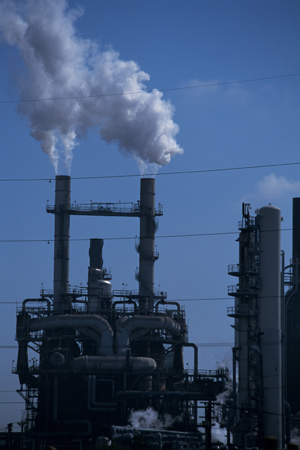
When you think of air, what do you think of? Maybe you think of the gas used to blow up a balloon or the air in a tire. But air is made of many things. We need some of these things to breathe. Some are things we might not want to breathe. Those things may be considered air pollution. What comes to mind when you hear the phrase “air pollution”? Is it a smokestack from a large factory? (See figure 2-1.) Is it a brownish haze in the sky over a big city? Or is it something you can’t see at all with just your eyes? In this activity, you will think about what makes up air and air pollution. Materials
Set up your technology notebook for a new activity. Remember to include the title of the activity and the date. Add this information to the table of contents.
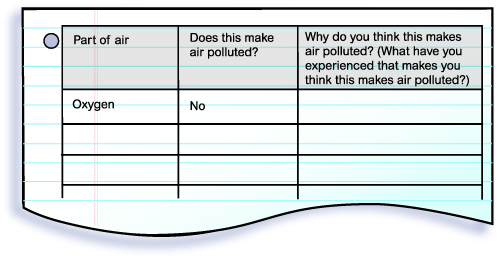
Draw a table like the one in figure 2-2 in your technology notebook. Notice that the first row has been filled out for you.
On your own, fill out as many of the parts of air as you can. Try to think of some ideas for things that are in polluted air and some that are in air that is not polluted. You may need to add more rows to the table.
Join with 2 other students to make a team and share your ideas. If your teammates have ideas that you think are good, add them to your table. Use a different color to add this new information. Hint
Watch as your teacher does a demonstration. Complete Steps 5a–c related to the demonstration.
- Draw the setup before the demonstration.
- Draw the setup after the demonstration. Add labels to help describe the observations you made.
- How does this demonstration relate to air pollution?
- Give an example of where you might see a similar situation in the world. In other words, what bigger event that is similar to this one might cause air pollution?
Activity Overview
In the Engage activity, What Is in the Air?, students begin by thinking about what they currently know about air. They also watch a demonstration to draw out what they know about air pollution.
Before You Teach
Materials
For each student:
- pens or pencils of different colors
For the demonstration:
- 1 candle with holder
- safety matches
- 1 heat-resistant white tile
- water for disposal of the match
Advance Preparation
In Step 5, you will lead a demonstration for students. You may wish to practice this demonstration in advance so you are comfortable with the demonstration and can hold the tile at the appropriate distance above the candle to get soot to form on the tile.
As You Teach
Outcomes and Indicators of Success
By the end of this activity, students will
-
develop an awareness of what is in air.
They will demonstrate their awareness by
- listing components of air
- describing the parts of air that they think are pollutants
- discussing their ideas with teammates.
-
begin thinking about what causes air pollution.
They will show their thinking by
- describing why they think certain parts of the air make it polluted
- relating a demonstration with a burning candle to a real-world situation.
Strategies
Getting Started
Begin by having students read the Chapter Overview and goals for the chapter. Go over the Chapter Organizer with students. They should read the key ideas of the activities and the linking questions.
Then, have them read the introduction to the Engage activity before beginning the investigation.
Process and Procedure
If necessary, remind students how to set up a new page in their technology notebooks. They should include the title of the activity and the date. They should also add this information to the table of contents in the front of their technology notebooks.
Students should draw a table like the one in the figure 2-2. Make sure that they fill out the first row as shown in the figure. This will help them understand what to put in the table.
Give students time to work individually to fill out what they can in the table. Emphasize that they do not have to have the right answer at this point in the 5E cycle, but to share their best ideas. This will help them and you see their current level of understanding.
Let students work in teams of 3 to add additional information to their tables. Make sure they use a different color for their revisions. This will help them keep track of their learning and new ideas.
Perform a demonstration for students.
- Light the candle. Dispose of the used match in a small container of water.
- Show the white tile to students so they can see that it is clean.
- Hold the tile over, but not touching, the flame of the candle for several seconds. You should see dark soot collecting on the tile.
- Ask students to describe what they see on the tile.
- Ask students what the dark spot is and where it came from.
Students should write their observations in their technology notebooks according to the steps listed in the student materials. If they have trouble thinking of places they might see this in the real world, ask them about when things burn in the real world. They might list a forest fire or a house burning. Ask if they think those events contribute to air pollution.