





In this chapter, you have learned about air pollutants, their sources, the harm that they may cause, and how different technologies have been developed to solve air pollution problems. In this Evaluate activity, The Light Goes On, but Which One?, you will use what you have learned to analyze a common product, the lightbulb. You may not think about lightbulbs as a technology related to air pollution. In some ways, you would be right. However, the power plants that make the electricity that lightbulbs need are a major source of air pollutants. How does this fact change your thinking about lightbulbs?
Write the focus question “How can choosing a lightbulb affect air pollution?” in your technology notebook. Draw a box around it. Then write your answers in your notebook. Hint
-
As you have learned in earlier activities in this chapter, producing electricity causes air pollution. Therefore, our decisions about things that use electricity can affect how many pollutants are added to the air. In this Evaluate activity, you will use what you have learned to assess three items that all have the same purpose. Read Need to Know: Changing Lightbulbs to learn about what you will do in this activity.
-
Work by yourself to summarize the benefits and costs for each type of lightbulb. Hint
-
Use the Think-Share-Advise-Revise (TSAR) strategy to compare your costs and benefits with a partner. Be sure to give helpful advice. Use a different-colored pen to revise or add information. Hint
-
On your own, decide which type of lightbulb you would like to use at home. Explain your reasons in your technology notebook.
-
Decide which type of lightbulb would be the best choice if your goal is to reduce air pollution. Explain your answer.
-
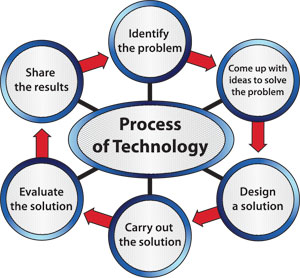
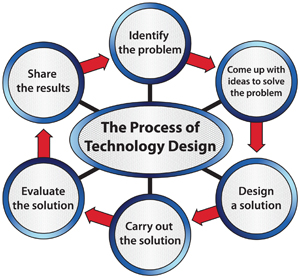
Review the Process of Technology Design Graphic. (See figure 2-17.)
- Do you think the people that designed these different types of lightbulbs went through these steps?
- In which step(s) would they have thought about costs and benefits?
- Describe what you think the engineers or designers did for the different steps of the process.
-
People are concerned about the energy that incandescent lightbulbs use. Some countries have now banned incandescent lightbulbs. The United States began phasing out incandescent lightbulbs in 2012. Some people do not agree with this decision. Write a paragraph to persuade officials about whether or not these bulbs should be used. Give evidence for your reasons using what you know about air pollution, benefits and costs, and the different types of lightbulbs that are available.
-
Turn in your work as your teacher directs.
Need to Know: Changing Lightbulbs
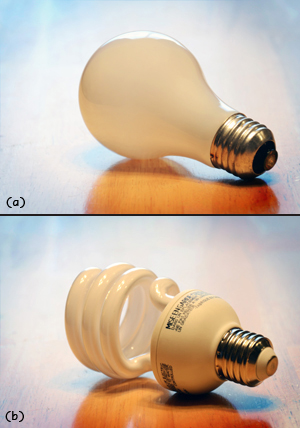
Think about the lightbulb that is in your typical lamp. It is probably one of two common types of lightbulbs—an incandescent lightbulb or a compact fluorescent lightbulb (CFL). (See figure 2-15.)
Incandescent lightbulbs have been the most common type of lightbulb for many, many years. People can buy them in a variety of shapes and sizes. This is the kind of lightbulb that many people are used to using. They are also relatively inexpensive to buy. There is a major concern about incandescent lightbulbs, however. Up to 90 percent of the power used by these lightbulbs is given off as heat rather than light.
Beginning in the mid-1990s, another type of lightbulb, the compact fluorescent lightbulb (CFL), appeared on store shelves. The main reason that people bought these lightbulbs was that they would last a very long time—much longer than an incandescent lightbulb. Another reason that people would buy CFLs is that they use about 75 percent less energy than incandescent lightbulbs. Some people didn’t like CFLs because the color of light was different and it made things look slightly different than incandescent bulbs. Some people have said that CFLs give off a strange odor. CFLs may not be available in sizes to fit all light fixtures. CFLs cost much more than incandescent light bulbs when you buy them. However, because of their longer life, you do not need to replace them as often as incandescent bulbs. Another issue is that CFLs contain mercury, which is toxic. This means that used CFLs should not be thrown away in the trash. Rather, they should be taken to a special disposal facility.
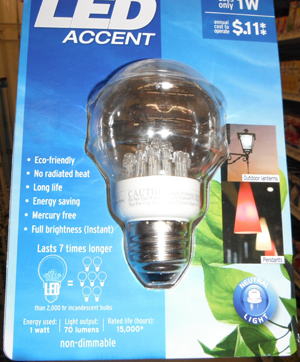
More recently, another technology is being used for lightbulbs. The newest category of lightbulb is the light-emitting diode (LED) lightbulb. (See figure 2-16.) LED lights have been around for many years, but not as household lightbulbs. One of the reasons that people are interested in LED lightbulbs is that they are much more energy efficient. LED lightbulbs can be up to 85 percent more energy efficient than incandescent lightbulbs. They are about 5 percent more efficient than CFLs. An LED light can reduce the amount of carbon dioxide in the air by hundreds of pounds each year. An LED bulb can last up to 20 years. At this time, however, not many people use LED bulbs to light their homes. LED bulbs are much dimmer than incandescent lights, and many people feel that the light is not bright enough. Another issue is cost. Depending on the bulb, an LED bulb can cost between $20 and $100.
Activity Overview
In the previous lessons, students have learned what air pollution is and have gained an appreciation of the consequences of air pollution. In this Evaluate activity, The Light Goes On, but Which One?, students will think about the relationship between technology and air pollution in a different way. Some products, such as lightbulbs, may not seem to be significant contributors to air pollution. However, the power plants that produce the electricity that the lightbulbs require are major sources of air pollutants. When thinking about the impact of choices, people may need to consider other factors than just the product itself.
As You Teach
Outcomes and Indicators of Success
By the end of this activity, students will demonstrate the ability to make decisions about technology based on an analysis of costs and benefits.
They will demonstrate their understanding by
- comparing different technological solutions to the same problem
- identifying and weighing costs and benefits for different solutions
- choosing and defending one solution based on the information they have.
Strategies
Getting Started
Begin by going over the Chapter Organizer again with students. They should read the key ideas of the activities and the linking questions. Have them read the introduction to the Evaluate activity before beginning the activity.
Process and Procedure
Students begin this lesson by writing their best response to the question “How can choosing a lightbulb affect air pollution?” Student responses will vary.
- Students will read about three different types of lightbulbs. Each type is a technology designed to solve the problem of providing light. Students should analyze the costs and benefits for each type of lightbulb.
-
Students should use the How to Use the Think-Share-Advise-Revise (TSAR) Strategy to compare their ideas with a partner. This strategy can ensure that students have all the information they need to complete the rest of the activity. The teacher version of How to Use the TSAR Strategy will provide some ideas for working with your students to use this strategy.
- Students write their decisions about the best type of lightbulb to buy. In Step 5, students may think the benefits of low cost and familiarity are most important, so they may state that incandescent lights are the best choice. In Step 6, students are asked to make a decision if reducing air pollution is a major goal. In that case, they might choose LED lightbulbs because they use the least energy. However, some might choose CFLs because they are also very energy efficient but are more affordable.
Students should review the Process of Technology Design graphic and think about how the steps in that diagram would have led to the development of different types of lightbulbs. Overall, the problem that designers wanted to solve relates to providing light for people. Designers would likely have thought about costs and benefits as they identified the problem and came up with ideas to solve the problem. They would have also thought about them as they designed the solution. An argument could be made that they considered them in all of the other steps as well as they thought about whether their solution was the “best” one for their problem and as they shared the results about what they did. Some technology designers may have focused on how to design a bulb that will provide light for people but use a small amount of energy. Technology designers had to make decisions about materials to use and the form that the bulb would take. They would also have to build the lightbulb. They would then have to test it to make sure it provides light, and if energy use was an important factor, test the bulb for its energy consumption. Then the lightbulb would be marketed to people.
Students consider a real-life issue related to air pollution, costs and benefits, and decision-making. In a variety of places, the incandescent lightbulb is being phased out because it is not energy efficient. Other people argue that laws shouldn’t specify what kind of lightbulb people can buy. Students need to consider which position they feel is best given the information they have at hand. They should then write a paragraph to persuade officials about whether to ban the incandescent bulbs.
Collect student work in a way that best suits you. Most of this work will be done in student notebooks, so this may be a good time to collect notebooks. Alternatively, you can wait to evaluate students until a convenient time to check or collect notebooks.