




Work with your team to answer the following questions. All teammates should write the answers in their technology notebooks.
Think about a family having a discussion.
- What is an example of a discussion in which a brainstorming session would be helpful? Why?
- What is an example of a discussion in which a brainstorming session would not be helpful? Why?
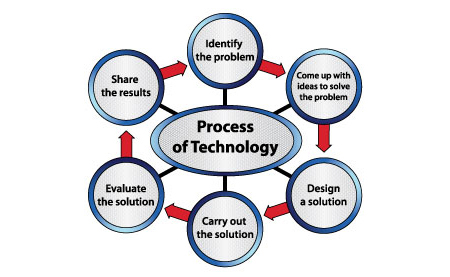
Refer to the process of technology design graphic. (See figure 4-4.)
- In which stage of the design does brainstorming help?
- How does brainstorming make a difference in the stage you listed in Question 2a?
- How do criteria and constraints make a difference in the stage you listed in Question 2a?
Describe how the solution your team decided on will help a person with the disability you have chosen. Include information about the criteria and constraints that you described in Step 2 of this activity.
- You practiced two different teamwork skills in this activity—sharing responsibility and contributing helpful ideas and actions. Why do you think this activity included work on two skills?
Answers to Reflect and Connect
Have students work in teams to answer the following questions. Remind them that all members of the team should have the answers written in their technology notebooks.
- Think about a family having a discussion.
-
What is an example of a discussion in which a brainstorming session would be helpful? Why?
Students will come up with different ideas for this question. Discussions that might be helped by having a brainstorming session are those about coming up with ideas for a vacation, the chores that need to be done at home, or what to have for dinner in a week. Other answers are acceptable. This question helps students think about the purpose of brainstorming sessions and when they are useful.
-
What is an example of a discussion in which a brainstorming session would not be helpful? Why?
Students will come up with different ideas for this question. Discussions that might not be helped by having a brainstorming session are those about bedtimes, what clothes to buy or wear, or what time to leave for school. Discussions requiring more discrete answers rather than many different ideas do not usually lend themselves to brainstorming.
-
-
Refer to the process of technology design graphic (figure 4-4).
In which stage of the design does brainstorming help?
This question helps students continue thinking about when brainstorming is useful. They will likely say that brainstorming is most helpful when coming up with ideas to solve the problem.
How does brainstorming make a difference in the stage you listed in Question 2a?
Brainstorming can make a difference during the stage of idea generation to solve the problem by giving people a chance to be creative and propose many possibilities. This helps make sure that a designer has an adequate supply of possibilities and can choose the best one.
How do criteria and constraints make a difference in the stage you listed in Question 2a?
Criteria and constraints make a difference when coming up with ideas because, even though creative solutions are encouraged in this stage, it is still important to make sure the product will meet the needs. Although some criteria and constraints are important to consider while brainstorming—for example, those that describe the problem to be solved—others are more important afterward as designers consider which idea they will choose to carry out.
-
Describe how the solution your team decided on will help a person with the disability you have chosen. Include information about the criteria and constraints that you described in Step 2 of this activity.
Students will have used different processes for deciding on the final solution they will develop. They should realize that they used a process of coming up with many ideas and then finding ways to narrow down their choices until they were left with just one.
-
You practiced two different teamwork skills in this activity—sharing responsibility and contributing helpful ideas and actions. Why do you think this activity included work on two skills?
Students should realize that brainstorming in a team requires a lot of teamwork. Each team member needed to partake in the brainstorming session, which included sharing the responsibility so that everyone had a role and actively thinking about sharing information that was useful to the team.