







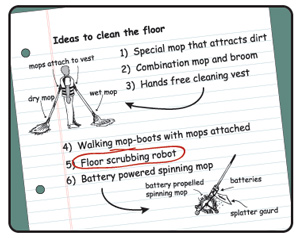
Have you ever heard of brainstorming? Brainstorming is a way to come up with many different ideas about a topic. Engineers and designers must be very creative. They need to make sure that they have thought of all the possibilities before they decide on a solution. Brainstorming is a good way to help them do this. They can then eliminate ideas to decide on the solution they will design, like the engineer in figure 4-5.
In the Engage activity, you worked with your team to identify a problem that might affect people with disabilities. Now, you will continue the process of technology design. In this Explore activity, Brainstorming, you will work with your team to come up with ideas to solve the problem. Materials
Have one person from your team retrieve the materials you will need for this activity. Place the chart paper on a wall using tape or tacks. At the top of the chart paper, write down the problem you decided on in Step 5 of the Engage activity. Hint
As a team, come up with a set of criteria and constraints that the solution will have to meet. List these on the chart paper underneath the problem.
Prepare for the brainstorming session by reading the Need to Know titled Brainstorming.
Need to Know: Brainstorming
Brainstorming is a way to come up with many ideas about a topic. You can brainstorm by yourself or as part of a group. In this activity, you will be working with your group to “brainstorm.” A few guidelines you should follow as you brainstorm are as follows:
- Share as many ideas as you can. The goal of brainstorming is to list as many ideas as possible. This will help you make sure you have thought of all the possibilities. You are more concerned with the quantity of ideas than the quality of ideas. Of course, think of your best ideas, but list everything that comes to mind.
- Do not judge or criticize ideas. During brainstorming, you want to list as many ideas as you can. This is a time to be creative and to come up with as many possible solutions as you can. This is not a time to comment on, add to, or judge ideas.
- Welcome unusual ideas. Be open to unusual ideas. Sometimes ideas that are unusual can be seen as a new way of thinking about a solution that had not been thought of before, and a better solution might result. Make sure your list includes both common and unusual ideas.
-
Assign roles within your team. You should have one person to do each of the following:
- Manager: Make sure the team is following the guidelines about brainstorming.
- Timekeeper: Keep track of when 10 minutes have passed. If the team gets off topic, bring it back to brainstorming.
- Recorder: Record the ideas from your brainstorming session on the chart paper. Hint
Spend 10 minutes brainstorming as many ideas as possible. Each idea should be a solution to the problem written at the top of your chart paper. Hint
-
Discuss each idea from your brainstorming session. Cross off any ideas that
- do not solve the problem
- do not work for a person with the disability you are focusing on
- are not reasonable for a team of middle school students to design
- are unsafe.
Discuss each of the remaining ideas by following Steps 7a–7b.
- Decide if the idea meets the criteria and constraints that you listed in Step 2. Cross off any ideas that do not meet the criteria and constraints.
- Talk about the strengths and weaknesses of each idea. Hint
As a team, decide on the one idea that you think would be the best for designing a solution to the problem. Draw a circle or box around that solution on your chart paper. Also, write down the idea in your technology notebook so you have a record of it.
Activity Overview
In this Explore activity, Brainstorming, students spend time brainstorming about ideas to solve the problem they identified in the Engage activity. They will work in their teams and practice the teamwork skills of sharing responsibility and contributing helpful ideas and actions.
Before You Teach
Materials
For each class of 30 students, teams of 3:
- chart paper or butcher paper (about 2 sheets per team)
- tape or tacks
- markers
- timer (optional)
Advance Preparation
In this activity, students will brainstorm ideas to solve the problem they chose in the Engage activity. By the end of this activity, they should have reached a decision about the technology they will create. Although they will not be building the technology or model until later in the chapter, at this point they will likely need to know what materials you will have available to them or whether they will need to provide their own materials. Decide in advance whether you will provide any materials and what those materials might be. Also, decide whether to allow them to use materials from home to supplement any that you provide.
As You Teach
Outcomes and Indicators of Success
By the end of this activity, students will
-
practice generating many ideas to solve a problem.
They will demonstrate their practice by
- participating in a brainstorming session with their teammates
- charting their ideas about solving the problem.
-
practice the teamwork skills of sharing responsibility and contributing helpful ideas and actions.
They will show their work by
- taking on a role in the brainstorming session
- discussing ideas from the brainstorming session and using criteria to eliminate ideas
- coming to a consensus on the idea that the team will develop into a technology.
Strategies
Getting Started
Have students begin by gathering with their teams. They should remind themselves of the disability and problem they had decided to address during the Engage activity. They should have written down the problem and drawn a box around it in their technology notebooks. Read the introduction. Refer students to the process of technology design diagram and have them identify which stage they will be working on in this activity.
Process and Procedure
Students should receive two pieces of chart paper or butcher paper and some markers. Have them hang the paper on the wall using tape or tacks. They will use these materials to chart their ideas as their teams carry out the brainstorming session. By having the paper on the wall, it helps to make their thoughts public so that everyone on the team can see them. Students should write the problem they are trying to solve at the top of the paper. You might also remind them to put their names on the back of the paper.
Teams should come up with the criteria and constraints for the product. They should be as specific as possible in their work. Students learned a lot about criteria and constraints in the first two chapters of this module, “Consumer Concerns” and “Diversity in Technology,” so you may want to refer them to some ideas in those chapters. Students should be reasonable with their lists, coming up with three to four criteria and constraints; however, the number will depend on the product they are trying to design.
Have students read the Need to Know Brainstorming. This Need to Know will provide them with information about what brainstorming is as well as some guidelines to follow as they brainstorm. Make sure they understand each guideline before they move on to Step 4. It is important that students realize that Step 3 is the time to come up with as many ideas as possible and that some of the ideas may be “silly” or unrealistic. Of course, they should not spend all their time trying to come up with completely unrealistic ideas; but at the same time, some “out-of-the-box” thinking helps generate ideas for new, interesting products. They should understand that in Step 5 (the actual brainstorming session), they will record all the ideas as they brainstorm, and it will not be the time to discuss the merit of those ideas.
Each team should have a manager, a timekeeper, and a recorder. Ensure that each team has assigned these roles. You might have the managers for each team raise their hands, followed by all the timekeepers, and then all the recorders, to ensure that each group has assigned all three roles. It will be easiest if you stop all students at the end of this step so that all teams can brainstorm for the same 10 minutes. This will help isolate the high noise level to one segment of the class and prevent teams from brainstorming and talking while other teams are trying to work on quieter steps.
Set a timer for 10 minutes and give teams that time to conduct the brainstorming session. They should think of as many ideas to solve the problem as they can. Circulate around the room as they work to ensure that they are just thinking of ideas, not discussing the merits of those ideas. Also make sure they are recording every idea. Finally, you may want to carry the chart paper or butcher paper with you so you can provide another piece of paper as students near the end of the current sheet. This will help keep them from spending time retrieving more paper instead of brainstorming ideas. Remind them that they should try to spend the entire 10 minutes thinking of new ideas.
Once teams have completed the brainstorming session, they should begin to discuss which ideas they might be able to develop. The criteria in Step 6 will help them eliminate a number of ideas fairly quickly. They should cross off ideas that are not viable according to these criteria.
Students should discuss each idea that still remains on their lists. They should evaluate each idea to see if it meets the criteria and constraints that they listed in Step 2. They should cross off any idea that does not meet the criteria and constraints. They should also talk about the strengths and weaknesses of each idea. It would be helpful for them to make notes in their technology notebooks about the strengths and weaknesses so they can remember their discussions. Tell them what materials, if any, you will have available to them, as this might limit the solution they can choose. They should consider the availability of materials as one of the strengths or weaknesses. Let them know that they will be creating the technology, or a model of it, in a later activity.
Have students come to a consensus on the one idea they think would be the best solution. They should indicate this solution on the chart paper and in their technology notebooks. Have them keep the chart paper (or store it for them). In the next activity, they will be asked often if they still think the idea they chose is the best one to solve the problem. If at any point they conclude the idea will not work, they will need to return to the team chart and choose a different solution.