






Technology and the Diversity of Limits

Yellow
Green
Blue
Red
Magenta
Remove
    Bookmark This Page
    Unbookmark This Page
    Module Overview
    Module Overview
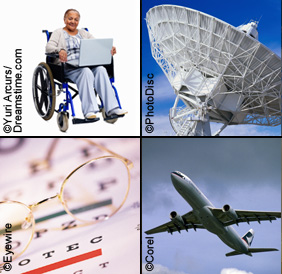
    Figure 1
    Figure 1: Examples of technology. The people who designed these items used the process of technology. They also had to consider other ideas as they designed their solutions. Which ideas might they have had?

    All humans have limits on what they are able to do. There is diversity among the limits. Some people are able to do certain tasks more easly than other people are able to do. But they might not be able to do other tasks as well. Sometimes we can change our limits. Technology helps us do this. Some people wear glasses or contact lenses. These technologies allow people to change the limit of how well they can see. Some people might use a car to get around. This changes their limits on how far they can go and how fast they can get there. In the "Doing Technology" chapter, you created a technology to help a small child extend his limits. He was able to turn on the light using your technology.

    Think about a technology, like the ones in figure 1. Someone had to design that technology to help solve a problem. That person had to do technology to come up with a design. Doing technology can also be called “engineering.” That person followed the process of technology design to come up with the solution. That person had to consider other ideas in addition to the process of technology. In this module, Technology and the Diversity of Limits, you will be introduced to some of the ideas that go into technological design, and you will take part in engineering activities. As you perform the activities, remember to think about what goes into developing tools and processes to change human limits.

    Goals for the Module
    • You will learn some basic ideas about design.
    • You will explore some of the technologies you already use.
    • You will think about how those technologies help people overcome limits.
    • By the end of the module, you will have new ideas about doing technology to share with others.

    The titles of the chapters are as follows:

      Chapter 1: Consumer Concerns
      Chapter 2: Diversity in Technology
      Chapter 3: Testing Your Way to a Solution
      Chapter 4: Masters of Design

    Module Overview

    The module’s theme is diversity and limits. The content is aimed at helping students understand how technology affects people in society. Students will continue to learn about the process of technological design as they solve problems. The nature of technological problem solving is addressed by having students explore concepts such as criteria, constraints, the design process, and the idea that “form follows function.” This last idea helps students understand that criteria and constraints limit the diversity of a design.

    In this module, Technology and the Diversity of Limits, students will perform activities to further develop the skills they learned in the Doing Technology chapter. They will continue to develop their understanding of the process of technological design, learn to read and develop data tables, solve problems, develop procedures, and consider how technology affects society.

    The activities require students to work in collaborative teams. Research shows that when they work in teams, students are able to share and exchange information with other students instead of having to rely on information solely provided by the teacher. This exchange provides a measure of autonomy to the learning process and, thus, a certain level of empowerment. Working in teams also allows students to practice teamwork skills, an important skill when they enter the workforce in the next decade or so. At times, the student materials will highlight these teamwork skills and instruct students to reflect on their work as part of a team.

    Goals for the Module

    By the end of the module, students should

    • understand the processes involved in designing and implementing a product, including accounting for human factors associated with individuals with disabilities;
    • understand the differences between design criteria and design constraints;
    • be able to explain that people work with a variety of criteria and constraints;
    • be able to design a product that accounts for constraints, including human factors, available materials, cost, and time; and
    • be able to design and conduct fair scientific tests, including creating operational definitions, deciding on variables in a test, and presenting results.

    The titles of the chapters are as follows:
    Chapter 1: Consumer Concerns
    Chapter 2: Diversity in Technology
    Chapter 3: Testing Your Way to a Solution
    Chapter 4: Masters of Design