







Are you ready to carry out your team’s solution? You spent time working on many of the details of the solution in the Explain activity. Now it is time to carry out the solution. In the Elaborate activity, Will It Work?, you will use everything you have learned in the previous chapters. You will have to keep criteria and constraints in mind. Because you are designing a product for someone with a disability, human factors will be an important constraint. You will need to test the product. You might have to test some of the parts of the product as well as the final product. Finally, you will use the rubric your team created to make sure the product meets the team’s characteristics for the most successful solution. Materials
-
With your team, go over the design you came up with in the Explain activity. Use the final drawing to make sure everyone on your team understands the design. As a team, answer the following questions (see figure 4-9):
- What materials do you need?
- Do any materials or parts of the product need to be tested? How will you do that?
- Is the rubric ready to use so you can determine whether the product meets your team’s characteristics for the most successful solution?
- Do you have the procedure your team wrote that will help you test the product?
- Do you have a data table drawn so that you can record the results of the tests?
- Which roles will each team member play in carrying out the solution? Hint
Figure 4-9: These students are discussing a design. Notice how one student is pointing to and explaining the design while another is taking notes. What do you need to do as you work to make sure your team is successful in designing the product?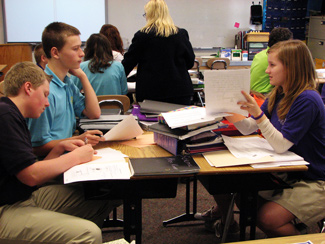
-
Gather the materials you need to build the product or a model of the product. Begin testing any materials or parts that need to be tested.
-
Build the product or a model of the product. Use the final drawing and labels as a guide. Make sure that everyone on your team is involved in this step. Practice the teamwork skill of contributing helpful ideas and actions as you work.
-
Use the procedure your team wrote to test the product. As you complete the tests, be sure that you complete a data table to record your results.
-
By yourself, fill out the rubric, based on your ideas about the product. For each row, circle the description that best fits the product. Hint
-
Compare your ideas from the rubric with those of your teammates. For any row in which you did not all circle the same description, discuss why you circled what you did. Come to a consensus about which description the product best fits.
-
If you have any additional time, you may make changes to improve the product. You should complete the tests again on the improved product. Revise the scores on the rubric if you need to.
Activity Overview
In the Elaborate activity, Will It Work?, students will build either the design or a model for the design. Once they have built the design, they will use the fair tests they described in the Explain activity to ensure that the product works the way they expected it to.
Before You Teach
Materials
For each team of 3 students:
- materials needed to build the project
Advance Preparation
Previous activities have had you describing the materials that will be available to students for the design. In this activity, students will need those materials to build the product. Collect the materials in advance and have them available to students in the classroom.
As You Teach
Outcomes and Indicators of Success
By the end of this activity, students will
-
demonstrate their understanding of a product design.
They will show their understanding by
- following the designs they created in the Explain activity as they build the product
- completing the rubrics about the product.
-
demonstrate their understanding of fair tests.
They will show their understanding by
- following the procedure they wrote in the Explain activity as they carry out a fair test
- completing the rubric based on the results of the test.
Strategies
Getting Started
Have students read the introduction to the activity. Then, have them make sure they have all the parts of the design listed in the introduction.
Process and Procedure
-
Give students plenty of time to work with their teams and make sure they have all the parts listed in Step 1. They will need these parts to carry out the solution.
-
Have students gather the materials. They may have questions about which material is most suited for a part. They should begin testing the different materials and parts at this point. For example, they may need to know if paper or Styrofoam is better for a particular part of the product.
-
Students should build the complete product in Step 3. They should use the final drawing from the Explain activity to help them work.
-
Have students test the product using the procedure they wrote in the Explain activity. Make sure they are recording their results as they complete the tests. These results will help them complete the rubric in the next step.
-
Have students work individually to fill out the rubric. They should circle the description that best fits the product. For example, they might circle the “best” description for the first characteristic but the “good” description for the second characteristic. They should do this individually so they have time to think on their own about how successful the product is. They will have a chance to compare their ideas with their teammates’ ideas in the next step.
-
Give students time to work with their teams to compare their rubrics. If they disagree about the descriptions the product best fits for any of the characteristics, they should discuss the reasons they chose the description they did. They should then come to a consensus about the description the product best fits.
-
If you have enough time, allow students to make any needed changes to the product. If they make changes, they should run any applicable tests again and change the scores on the rubric.