




What kinds of decisions do you think communities have to make about their own garbage disposal? Although it would be nice if cities could make an immediate switch to better ways of disposing of their garbage, they cannot usually do that. In this Evaluate activity, Out in the Desert, you will consider some of the issues that communities face. Then you will make recommendations about what the community should do. Materials
-
Read the Hazardous Waste scenario to learn more about the situation you will be working on. You can also read along on the master Hazardous Waste.
Hazardous Waste
Imagine that you work for a company that advises communities on how to handle waste. A member of Congress has asked your company to make some decisions about a hazardous waste area in the desert. Currently, the waste is stored in a landfill in an isolated area of Nevada, as shown in figure 1-14. Very few people live nearby. Recent studies by geologists have shown, however, that the area has a high potential for earthquakes. The waste is liquid and is stored in steel barrels. For a long time, the barrels were the only waste in the landfill, but lately another community has been sending some of its garbage there.
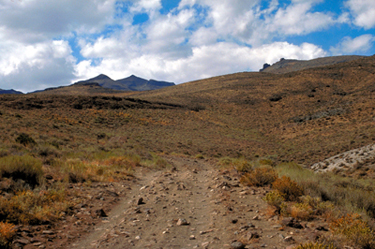 BLM / NevadaFigure 1-14: Hazardous waste is sometimes stored in isolated areas. Landfills and other waste disposal can have serious consequences, even when there are not many people in the area. What do you think some consequences might be?
You have the following options:
Leave the waste where it is in the landfill. The probability of an earthquake affecting the barrels is 9 percent each year for the next 30 years. After 30 years, the barrels will be slightly more rusted. This means they would be more easily damaged if an earthquake occurred. At that point, the probability that an earthquake would affect the barrels goes up to 15 percent. If a leak occurs, there is no way to stop it.
-
Transport the waste to a Nevada city. The probability of a traffic accident while the trucks are moving the barrels is 8 percent. Once the waste reached the city, it would be burned in an incinerator. The liquid waste would boil away. The remaining waste would be reduced to ash. The ash could then be cemented into concrete blocks. The cement would be used to help protect the environment from the hazardous waste.
The people in the city have organized a protest against this idea. They do not want the waste transported into the city or burned in the city. They also do not want concrete blocks of burned waste to be stored nearby. Transporting the blocks away from the city means that the cost of transportation would be doubled—once to transport the barrels of waste and again for the blocks. This would raise the cost of the disposal method to $60 million. The incinerator would also need a scrubber installed to catch ash. This would increase the costs of the project to $70 million. If this method is adopted and completed without any accidents, there would be no future worry about chemical leaks from the waste.
-
Build an incinerator near the current area. Burn the waste that is in the barrels now and cement the ash into blocks. The workers and materials required to build the incinerator would have to be transported to the isolated area. Because of this, the cost of the project would be $70 million. The incinerator has a probability of increasing air pollution by 16 percent. The ash could reach a small city 200 miles away. Again, the option of a scrubber is available, but this would raise the cost to $80 million. If the project is completed, there would be no future leaks to worry about.
-
Move the waste to another isolated area with a lower risk of earthquakes. The probability of traffic accidents is 8 percent. The cost would be $2 million. This probably would prevent damage to the barrels from an earthquake, but the old barrels would eventually rust. There would be no way to stop leaks when they occur.
-
Place the barrels on the ocean floor. This would cost $6 million. The company would have to transport the barrels through a large city. This raises the probability of a traffic accident to 12 percent. The barrels would corrode and leak more quickly in the ocean than in the desert, but there would be no people living nearby.
-
Describe why you think the hazardous wastes were originally stored in the desert.
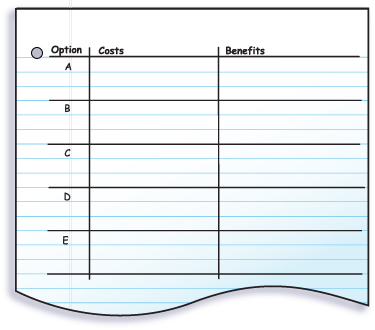 Figure 1-15: A cost and benefit table. Draw a table like this one in your notebook. Then fill out the costs and benefits for each of the five options.
 -
Draw a three-column table in your notebook like the one shown in figure 1-15. Label the first column “option.” List the letters of the different options in the column. Label the second column “costs.” Label the third column “benefits.”
-
Complete the table by yourself. For the costs column, list all of the reasons why the option is not the best. In the benefits column, list all of the reasons that the option is a good one. Be sure to include the costs and benefits of any technology that is involved in the solution. Hint
-
Join with a partner. Discuss your ideas about the costs and benefits of each option. Do not discuss which option you think is best. Revise your table in a different color if you need to.
-
Work by yourself to write a letter to Congress describing
- which choice you think is the best one
- why you made your choice (Use evidence from the scenario and your table to justify your answer.)
- what actions the community that is sending waste to the landfill can take to help reduce the amount of trash they send.
Activity Overview
Students read a scenario about waste disposal in a community. They play the role of someone who works at a company that advises communities on how to dispose of waste. Students consider the possibilities and make a decision about what the community should do. They then write a letter to Congress to describe their decision.
Before You Teach
Materials
For each student:
- pens or pencils of different colors
- 1 copy of Master 1-4, Hazardous Waste
As You Teach
Outcomes and Indicators of Success
By the end of this activity, students will
-
understand that no one action can solve the garbage disposal problem.
They will show their understanding by
- creating a table that shows the costs and benefits of the options
- writing a letter to justify the choice they make about what the community should do.
-
communicate scientific ideas about a problem.
They will demonstrate their communication skill by writing a letter to Congress to describe the action that should be taken.
Strategies
Getting Started
Hold a brief discussion with students about whether they think one solution can solve all of the garbage problems people face today. At this point, students should realize that no solution is perfect. Landfills and incinerators will likely not be able to take care of all trash in the future, nor will recycling, reducing, and reusing. Discuss the idea that each community needs to make decisions that best fit the needs of that community. Have students discuss how those decisions can be made. Students should come up with some idea that relates to weighing the costs and benefits, though they may describe their idea as pros and cons or advantages and disadvantages. Help them understand that advantages, pros, and benefits are all related, as are disadvantages, cons, and costs. Tell them that in this activity, they will be asked to make a decision about the best option for a community’s waste disposal. To make their decision, they need to weigh the costs and benefits of each option. The problem does not have one correct answer. Share with your students that you are not be looking for a particular option choice in their answer, but rather that they have been able to reason through and justify the choice they made.
Process and Procedure
-
Have students read the scenario. They may follow along on Master 1-4, Hazardous Waste. You may wish to have them read the scenario aloud in class to make sure that all students hear and understand what they will be doing. You may wish to have a brief discussion about probability. Although students do not need a thorough understanding of probability to complete this activity, make sure they realize that a 12 percent chance of something happening means that there is some risk there, but it does not necessarily mean that that event will occur.
-
Allow students time to describe why they think that the wastes were stored in the desert. It is likely that the wastes were originally stored there because fewer people live in that area. This means that fewer people would be affected by any problems in the desert and that fewer people did not want the waste stored there. This is an opinion question, so students may have other ideas that are acceptable.
-
Have students draw the table in their technology notebooks. Make sure students understand the ideas of costs and benefits. It may help to remind them that advantages and pros are similar to benefits and that disadvantages and cons are similar to costs.
-
Students should complete the table individually. Tell them that they will eventually need to make a decision about the best option for the community, so they should list all of the costs and benefits that they can think of. Figure T1-2 shows some of the ideas that students may include in their tables. Other ideas may be acceptable. Remind students that they will have to make a final decision based on this evidence, so they should include all of the costs and benefits they can find in their tables.
-
Allow students time to join with a partner and compare tables. They should discuss the costs and benefits that they listed for each option. They should not discuss which option they think is the best one. If they learn new information during their discussion, they should revise their answers in the table.
-
Remind students that in the scenario, Hazardous Waste, a member of Congress had asked them to explore the Nevada waste options. In this step, they should write a letter to Congress explaining the option they think is the best one. They should justify their ideas using evidence from the scenario and their tables. Accept any choice as long as students clearly explain their reasoning. In addition, they should include recommendations for the community that has begun sending garbage to the Nevada landfill. The students should have some ideas about reducing, reusing, and recycling to help reduce the amount of garbage the community sends.
