






You make choices about garbage every day. Some decisions make it easier to get rid of garbage and some make it more difficult. In this Elaborate investigation Reduce, Reuse, Recycle Choices, you will play a game about these decisions. The goal of this game is to get rid of your garbage. You and your classmates will decide on the consequences of 24 different actions before you play the game. You will also work on the teamwork skill of coming to a consensus. Materials
-
Get the materials your team needs. Set aside all of the materials except the game board, like the one in figure 1-10, and the transparency or dry erase marker.
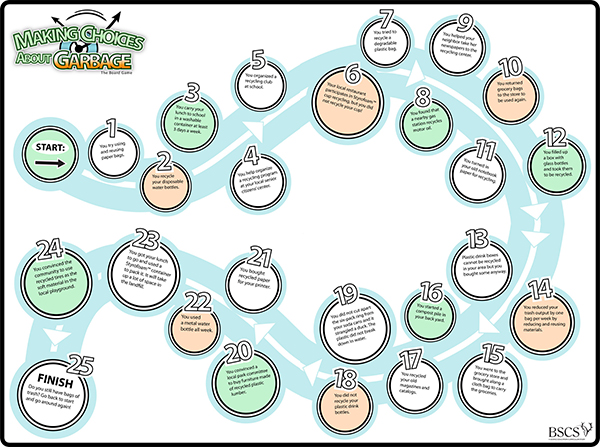 Figure 1-10: The Making Choices about Garbage game board. Discuss each of the spots on the game board with your team. Each spot describes an action that will either increase or decrease the amount of garbage produced. You will decide how much the action will affect garbage production.
 -
Your teacher will assign some of the actions written in the spots on the game board to your team. Read the actions assigned to your team. Each spot describes an action that a person could take.
-
With your team, decide whether the actions will increase or decrease the amount of garbage. Practice the teamwork skill of coming to a consensus. That means you should all discuss your ideas and try to reach an agreement on your decisions.
- If you think that the action will increase the amount of trash, draw an arrow that points up (↑) by the spot on the game board.
- If you think the action will decrease the amount of trash, draw an arrow that points down (↓) by the spot on the game board. Hint
-
With your team, agree on the number of plastic game pieces players should pick up or discard if they land on the spot. Each plastic piece represents a bag of garbage. Decide on 1, 2, or 3 pieces and write the number next to the arrow from the previous step. Continue working on your teamwork skill. Hint
-
Participate in a class discussion about the game board. Be ready to share the ideas your team had in Step 4 about what each spot should be worth. Once the class has reached a decision, add the consequence to your game board. Hint
-
Prepare to play the game by reading Rules for Making Choices about Garbage. Ask your team or teacher questions if you do not understand any of the rules.
Rules for Making Choices about Garbage
- Choose the token that you will use. This will mark where you are on the game board.
- Count out 20 plastic game pieces or beans for yourself. Each one represents a bag of trash.
Decide who will go first by using the spinner. The highest number goes first. The middle number goes second. The lowest number goes last.
- On your turn, use the spinner to determine the number of spaces you should move.
- Move your token the number of spots shown on the spinner.
- When you land on a spot, read the action aloud to your team. Discard or take the number of plastic pieces or beans that your class agreed on for that spot. Put the discarded pieces or beans into the bowl so you do not lose them.
- More than one token can be on a spot at the same time.
- Continue going around the board until at least one person has discarded all of his or her trash. If time allows, continue playing until everyone has discarded all of his or her trash.
Before You Play
Playing the Game
-
Play the game.
-
In your notebook, create a 3-column table like the one in figure 1-11. Label the three columns “recycling,” “reducing,” and “reusing.”
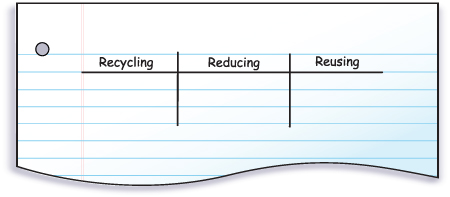 Figure 1-11: In your notebook, create a 3-column table like this one. You will use the table as you read Garbage Alternatives.
 -
Read Garbage Alternatives to learn more about recycling, reducing, and reusing. As you read, list examples of each in your table. Also, complete the task within the reading.
Garbage Alternatives
As you learned in the Explain activity, landfills and incinerators are not perfect solutions. Because of this, people have been looking for alternative ways to dispose of items. One alternative is recycling. Recycling can be as simple as the practice of reusing a material. More commonly, it means to process the material to create a new product. By doing this, the materials repeat a cycle. They become other products and are used again. In the United States in 2011, about 34 percent of waste was recycled. Some experts estimate that we could recycle 40 to 60 percent of our waste. But recycling requires more effort than just bagging up the trash. People must sort the trash into separate containers. In some areas, they have to take recyclable materials to a special location. In the 1990s, many waste disposal companies began to pick up recycling as well as garbage at people’s houses, as in figure 1-12. The most commonly recycled materials include aluminum, metal, glass, paper, and certain plastics.
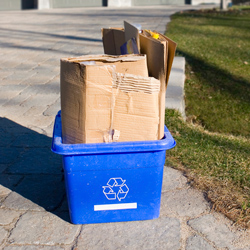 © Imageegami | Dreamstime.comFigure 1-12: A home recycling container. In the 1990s many waste disposal companies began picking up recycling at people’s homes.
Recycling is not just about making sure you put materials into recycling bins. It also involves careful purchasing. This is called precycling. For recycling to work, people must buy products that can be recycled. It also helps to buy products that are made from recycled materials. You can also consider buying products that have the least amount of packaging. Waste from the packaging around products accounts for almost one-third of the garbage we send to landfills.
Recycling does have its limits. Some materials, such as certain types of plastic, require a lot of energy or chemicals in order to recycle them. For some plastics, it requires as much energy to recycle them as to make new plastics. Paper can be recycled several times before the fibers in it cannot be reused. After paper has been recycled many times, the fibers become too brittle and can no longer be used to form paper. Some mixtures of materials can also be a problem. For example, when paper and plastic are laminated together, as we often see with fast food wrappers and juice boxes, it is more difficult to recycle them. In the past, these items could not be recycled at all. Today, technology has improved so many recycling facilities can now separate the paper and plastic. Task
Reducing is another way to prevent so much trash from going to landfills. Reducing means that people try to use products with less packaging. It also means that people avoid purchasing disposable products when they are not necessary. For example, maybe you take water to school. If you practiced reducing, you would take it in a hard plastic or metal bottle. You would be able to use that bottle many times. That means you would reduce the number of disposable water bottles you throw away.
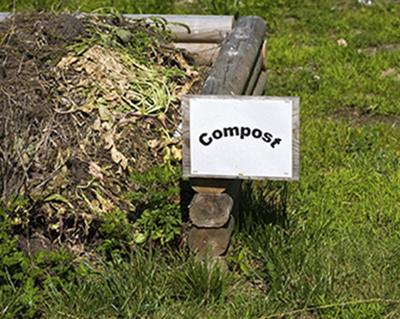 © Amy Riley / iStockphoto.comFigure 1-13: A compost pile. Materials such as food scraps, leaves, and shredded newspapers can be included in a compost pile. After weeks or months, the compost breaks down into material that is rich in nutrients. It can be used for fertilizer or to cover landfills.
Another way to lower the amount of trash people produce is to reuse materials. Reusing means that you use an item again and again. You might use a plastic bag from the grocery store several times before you throw it away. First you would carry your groceries home in the bag. Then you could carry your lunch in it and later put your wet umbrella in it. You might then put used cat litter in it before you finally threw the bag away. This would mean that you used the bag four times before you recycle it or put it in a landfill.
Even materials like food scraps and grass clippings can be reused, through composting. Composting can break down plant-based waste into materials that add nutrients to soil. Many items can be composted, including many food scraps, leaves, grass clippings, shredded newspapers, and ashes from fires.
Materials in a compost pile, like the one in figure 1-13, can decompose within a few weeks or months. For material to break down to compost, it needs several factors: air, water, warmth, and soil microbes. Soil microbes are plants or animals that live in soil. They are so small they cannot be seen without a microscope. For everything to work together to break down garbage, the compost must be kept near the surface of the pile. People who keep compost piles often turn or “stir” them to help keep all the compost available to air.
Keeping a compost pile has several advantages. First, composting costs very little, even on a large scale. The only costs are shredding the garbage and turning the compost so it breaks down quickly. Second, items that are composted become material that is rich in nutrients. It can be used as fertilizer or covering for landfills. Third, if communities use compost to cover landfills, they will save money because they will not have to buy soil to cover the landfill. Finally, and perhaps most important, composting reduces the amount of garbage that goes to landfills. Many experts believe we could compost about 20 percent of our garbage each year.
-
Make sure you have filled out the table with examples from the reading. Then add at least two more examples to each column of the table. These examples should not be from the reading. Hint
-
Participate in a class discussion about your work in this activity.
Activity Overview
In this activity, students learn more ways they can deal with their waste materials. To do this, they consider what different actions should be worth when they play a game. The class works together to make decisions about the consequences of each action. Students then play the game.
Before You Teach
Background Information
Reducing, reusing, and recycling are terms that have become popular in many areas.
Recycling is probably the most common. Recycling turns products that would have been disposed of as waste into usable materials. Recycling has two aspects to it. The first is choosing items that have been made using recycled materials. The second is to choose products that can be recycled and recycling them.
Materials that are commonly recycled include paper, glass, plastic bottles, steel cans, and aluminum cans. Regardless of the type of material, the items are cleaned and separated. The items are then processed into raw materials that can be used in the manufacture of other products. For example, recovered glass has been used as a component of roadway asphalt. Recovered plastic is used in park benches, carpeting, and pedestrian bridges.
Reducing refers to creating less waste. This can be done at a production level. This is often called “source reduction.” Source reduction refers to actions such as reducing the amount of packaging for a product or using fewer hazardous components. Source reduction may also include actions such as using materials that have been or can be recycled. The goal is to have less waste. Reducing the amount of waste that is produced saves on the costs of recycling or disposing of materials.
Individuals can also practice reduction. One example is to make sure people minimize the amount of paper they use. Examples include printing double-sided pages or using the back of single-sided sheets as scratch paper. Another way individuals can practice reduction is to pack waste-free lunches. This includes using containers that can be washed and reused and using a lunch bag or box that is not thrown away.
Reusing is, in some ways, closely related to reducing. Reusing is the practice of continuing to use a product rather than purchasing a new one. Using plastic containers for lunches is one example. Other ways to reuse products include using plastic bags for more than one purpose, such as bringing home groceries in a bag, carrying lunch in it, putting a wet umbrella in it, then using it for dog waste or cat litter before throwing the bag away. Reusing also includes repairing and maintaining items rather than throwing them away; borrowing, renting, or sharing items that are used infrequently; and donating or selling items when they are no longer needed.
Composting is another choice that some people make. According to the EPA, yard trimmings and food waste make up about 26 percent of the items people throw away (http://www.epa.gov/osw/conserve/rrr/composting/). These are materials that can be turned into compost and used as a medium to grow plants or gardens.
In environmental education, students often feel overwhelmed or feel like nothing they can do can make a difference. This activity is meant to help them understand the small actions they can take. If many people make small actions, it can make a big difference in the amount of garbage people produce.
Materials
For each class of 30 students:
- 10 copies of Master 1-3, Making Choices about Garbage Game Board
- 10 large bowls, such as margarine tubs
- 30 tokens for moving along the game board, such as colored paper clips, coins, sticky notes, and so on
- 10 spinners (see Advance Preparation)
- 600 plastic game pieces or beans
- 10 transparency or dry erase markers
- 8.5” × 11” paper (optional; see Step 11)
Advance Preparation
Make copies of Master 1-3, Making Choices about Garbage Game Board. Combine each set of pages to make one game board. Laminate the boards. Students will use transparency or dry erase markers to write on the board.
If you do not already have spinners, you can assemble them. You will need:
- 10 file folders
- a piece of cardboard from a cereal box
- 1-hole punch
- 1 pair of scissors
- 1 saucer or large beaker
- 1 ruler
- 1 felt-tipped pen
- 10 brass brads
- masking tape
To assemble the spinners, use the following steps.
- Draw a large circle on each file folder using the saucer or beaker as a guide. Divide the circle into six sections. Number each section 1–6.
- Cut out 10 cardboard arrows in a size that fits the circle.
- Punch holes through the arrow and the center of the circle drawn on the file folder. Only punch through the layer of the folder on which the circle is drawn.
- Insert the brass brad into the hole in the arrow and into the top half of the file folder. Bend back the arms of the brad so that the arrow is attached to the folder but can spin freely.
- Cut the folders to the size you choose and tape the sides together with masking tape. The arms of the brad should be sandwiched between the two layers of the file folder so that students cannot easily remove them.
As You Teach
Outcomes and Indicators of Success
By the end of this activity, students will
-
understand that people’s decisions can affect the amount of garbage they produce.
They will show their understanding by
- deciding on the appropriate consequence of each action described on the game board
- justifying why certain events should require a gain or loss of garbage tokens
- describing their own ideas about what to do with garbage.
-
practice the teamwork skill of coming to a consensus.
They will demonstrate their skill by
- working in a team to come to a consensus about the consequences of certain actions
- participating in a class discussion to decide on the consequences of actions.
Strategies
Getting Started
Ask students for alternatives to throwing items in the trash can. Most students will name recycling. If they have read the title of the activity, they may also name reducing and reusing. Ask students for examples of each of the alternatives. Make a note of any misconceptions students might have about these alternatives, but do not correct them at this point. They will learn more about recycling, reducing, and reusing as they work through the activity.
Process and Procedure
-
Have students gather the materials they will need. If you feel that students will not be able to set aside the other materials, you can first have them obtain just the game board and the pen, then pass out the other materials as they work or as they finish discussing their ideas.
-
Assign several actions to each team. In a class of 30, you should have 10 teams. We recommend having each action discussed by two different teams. Try to assign the numbers in such a way that teams are not considering a set of actions that is exactly the same as a set of actions another team is considering. For example, one team might consider 2, 8, 13, 17, and 21 while another team is considering 1, 9, 13, 15, and 21. This allows for two teams to consider each action but does not allow teams to simply compare and copy the decisions of another team. Note that action 25 simply tells students to go around the board again if they still have bags of trash, so that action does not need to be included in this step. It may help to have the team assignments written on the board so that students can easily find the actions their team should consider. Have students read each of the actions they are assigned and make sure they understand what the action means.
-
Give teams time to decide whether each of the actions they are assigned will increase the amount of trash produced or decrease the amount of trash produced. They should use their transparency or dry erase pens to draw arrows on the laminated game board in the appropriate square.
Make sure students are working on the teamwork skill of coming to a consensus. This means they should take the time for each person on the team to share his or her ideas, then work toward an agreement. As you circulate around the room, make sure that one student on a team has not taken over and is deciding by him- or herself. In addition, consensus does not mean that everyone on a team votes and that the majority represents the decision. Make sure that all students discuss their ideas and that the team works to come to an agreement that is suitable for all team members.
-
Once students have decided whether each action increases or decreases the amount of trash, they should assign a number of plastic game pieces (between 1 and 3) that the action is worth. Each plastic game piece represents one bag of garbage. Make sure students read the hint so they understand how they should make their decisions. Also make it clear that 1, 2, and 3 represent changing the amount of trash by a low, medium, and high amount, rather than by a specific number of bags. Students should continue working on the teamwork skill of coming to a consensus.
This step may prove harder than the previous one, so remind students to justify their ideas and to discuss why they think a particular number of pieces should be assigned to that action.
-
Hold a class discussion about the different actions. At least two teams should have discussed each action, so ask those teams to share whether they decided the action should increase or decrease the amount of trash and by how many pieces. Come to a class consensus for each of the actions listed in 1-24. Remember that number 25 is the one that instructs students to go around again if they still have trash.
Once you have assigned a value to all of the actions, give students an opportunity to study them again to make sure nothing seems to be assigned an unreasonably high or low value. For example, different teams may have assigned different values to action 20 (You convince a local park committee to buy furniture made of recycled plastic lumber.) and action 24 (You convince the community to use recycled tires as the soft material in the local playground.); but those actions probably have a similar impact. Make sure that the final numbers reflect comparisons such as these. For your knowledge, there should be more actions that reduce trash than increase trash. The actions that increase trash are the following:
Action 6. Your local restaurant participates in Styrofoam™ cup recycling, but you do not recycle your cup!
Action 7. You recycle a degradable plastic bag.
Action 13. Plastic drink boxes cannot be recycled in your area but you buy some anyway.
Action 18. You do not recycle your plastic drink bottles.
Action 19. You do not cut apart the six-pack ring from your soda cans and it strangles a duck. The plastic does not break down in water.
Action 23. You get your lunch to go and use a Styrofoam™ container to pack it. It will take up a lot of space in the landfill.
There are more actions that reduce trash to help students think about some of the different actions that they can take to help contribute to a solution. Make sure that each team adds all of the consequences (↑2, ↓1, etc.) to their own game board once a final decision has been reached. They should also revise their own squares if the class came to a different consensus during the discussion.
-
Have students read the rules for playing the game. Give them time to ask any questions they may have.
-
Allow about 20 minutes for the teams to play the game. This should allow enough time for at least one student on each team to discard all of his or her trash. If enough time is left, the others may continue to see who places second. Be aware that the main learning goal of this activity is to determine the consequences of the actions, so do not allow the game playing to continue for more than 20 minutes.
-
Have students create the table about the garbage alternatives in their notebooks.
-
Students should read Garbage Alternatives to learn more about these concepts. As they read, have them put examples of each action into their tables. They should also answer the Task question in their technology notebooks.
Task Students should recall that a technology is anything that helps humans solve problems. Recycling is a way to help humans solve the problem of disposing of trash. Because recycling allows people to use some or all of a product again, it reduces the amount of trash that is produced, meaning less garbage has to be put into landfills or incinerated.
-
In Step 10, make sure that students have added examples from the reading to their tables. Students should then add additional examples to each column. These should be examples that were not in the reading. The hint reminds them that they may want to use the game board. They may also come up with their own ideas. This step is meant to make sure that students understand the different concepts and to inspire additional thinking about the actions people can take to reduce the amount of garbage.
-
The class discussion should focus on the examples of reducing, reusing, and recycling that students provided. This may lead back to some discussions about the game, as some students may now feel that actions should have had different consequences. One option is to have students write examples of what they can do on sheets of 8.5” × 11” paper and post them around the room. This will help them remember their ideas later.