




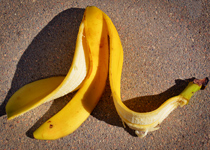
Everyone has trash that gets thrown away. Many products that we use have packaging that we want to get rid of. Maybe we had a banana or an orange as a snack and need to throw away the peel, as in figure 1-2. We might have messed up some of our work and want to discard the paper. What other items do you throw away? Have you ever thought about how much trash you throw away in a day?
In this Engage activity, Tracking Your Trash, you are going to find out. You will keep track of everything you throw away in a given day. It may be more than or less than the amount you throw away on a different day. But it will give you a rough idea of the amount of trash you produce. Materials
-
Set up your technology notebook for a new activity. Write the name of the activity and the date on a new page in your notebook. Add this information to the table of contents.
-
Make a prediction about how many items you throw in the trash each day. Write the following sentence in your technology notebook and fill in the blank.
I think I throw away __________ items on a typical day.
-
Discuss your prediction with a partner. Also talk about whether you think your number is more than or less than the number of items other people throw away. If you would like to revise your answer after your discussion, use a different-colored pen or pencil. Hint
-
Draw a 2-column table in your technology notebook. Label the first column “things I threw away.” Label the second column “things I recycled or reused.”
-
For the next 24 hours, keep track of every item you throw in the trash. List these items in the first column of the table. If you recycle or reuse any items, list those in the second column. Hint
-
After 24 hours, count the items in the first column. How does this number compare to your prediction from Step 1?
Activity Overview
In this activity, students first make a prediction about the amount of trash they throw away each day. Then they keep track of everything they throw away one day. They consider how much they throw away and whether there are any patterns to their garbage disposal.
Before You Teach
Materials
For each student:
- pens or pencils of different colors
Advance Preparation
Over the course of this chapter, students will learn more about different methods of dealing with garbage, such as landfills and incinerators. They will also learn about recycling and composting. You may want to connect these ideas to your local community. If so, take some time to learn about what happens to the garbage in your community. Also determine what the recycling options are in your community. For example, in many communities, only certain items are picked up curbside. Other items may be recycled if they are taken to a local recycling center. Some communities also have large areas for composting.
As You Teach
Outcomes and Indicators of Success
By the end of this activity, students will
-
become interested in the amount of garbage that people dispose of in a day.
They will show their interest by
- tracking the items they throw away in a day
- looking for patterns in the garbage they throw away
- thinking of ways to reduce the amount of garbage they produce.
-
practice looking for patterns and trends in data.
They will practice this skill by trying to recognize patterns in the garbage they throw away.
Strategies
Getting Started
To begin, have a student read the introduction to the activity. Lead a discussion about the questions in the introduction, asking students what kinds of things they throw away in a day. If a student brings it up, you might also talk about items that can be recycled instead of being thrown in the trash.
Process and Procedure
Make sure students set up their technology notebooks for a new activity.
Students will make a prediction about the number of items they throw away. To do this, they should copy the sentence provided in the step into their technology notebooks and fill in the blank. Remind them that this is a prediction, so they should think carefully about their answer, but that it is okay if it is not correct.
Students should discuss their predictions with a partner. As part of their discussion, they should think about how much they think other people throw away, including adults. Give an example of a parent making dinner and ask if that activity would add to the amount of trash. If students would like to change their prediction after their discussion, they can do so in a different color. Using a different color helps students track their learning and reinforces the idea that they do not always have to begin with a correct answer.
Students should draw a two-column table in their notebooks with the headings listed in the step. This will likely wind up being a fairly large table, so you might want to have students start it on a new page in their notebooks.
Over the next 24 hours, students should keep track of every item they throw away. For example, they might list an apple core, a candy bar wrapper, a piece of paper, and a piece of gum. Tell them that they should keep their table with them at all times for the next 24 hours and list every item they throw away. There is also a place in the table for students to record if they recycled or reused any items, such as a water bottle or an aluminum can.
During the next class, have students count the number of items that are in the first column of their table. Have them write a sentence to explain how this total compared with their prediction in Step 1. You may wish to hold a brief discussion about whether any students were surprised by the amount that they threw away.