

In the Explore activity, you and your team designed a house to withstand wind. You then used what you learned from testing your team’s design to make changes. The house your team constructed was a model, and it was very different from a real house, and the testing you did included a situation that is very different from what a real house would go through. But you probably did see that changes in design can lead to a better outcome.
The design of your team’s house may have been very different from those of other teams in your class, and after testing, other teams may have made different decisions about how to change their designs. In this Explain activity, Decisions Are Part of the Design Process, you will think about how people make design decisions. Sometimes it can be difficult to make decisions. Whether you are making decisions about designing a house or making decisions about anything else in life, you obviously want to make the best choice the first time rather than making a series of random choices. (See figure 4-9.) How can people make the best decisions from the start? Materials
-
Look back at the Explore activity in your technology notebook. Think about the choices you and your teammates first made for the house design. Then, think about the decisions you made when you changed the design. With your teammates, discuss
- the kinds of decisions you had to make when designing the house
- why you chose certain materials instead of others for the first design
- why you chose certain materials for the changes to the design after testing.
-
Imagine that your team could have chosen any materials it wanted to build the model. Also imagine that your team could have used as many tokens as it wanted to buy materials. How would you have designed the paper house? Discuss your ideas with your teammates. Hint
-
Read Decisions, Decisions to learn more about the decision-making process. Hint
Read Need to Know: The Model House Contest to learn about a situation in which costs and benefits are evaluated.
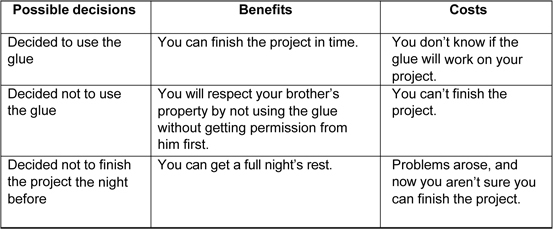
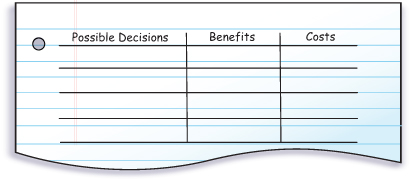
In your technology notebook, draw a table like the one in figure 4-11 to record your ideas. Work alone for this part of the activity.
- Write at least three possible options you could consider as the next step in the model house contest.
- For each option, write the benefits and the costs considered while making the overall decision. Hint
-
With your teammates, discuss the options that you thought of. How do your ideas compare with those of your teammates? Did you think of the same benefits and costs for each possible option? Use a different-colored pen or pencil to add new ideas, benefits, and costs to your table.
-
After discussing the options with your teammates, which decision would you make after evaluating the benefits and costs? Mark the option that is your top choice and the option that is your bottom choice. Explain your choices. Hint
Decisions, Decisions
As your team first thought about building the house in the Explore activity, did the walls of the wind-resistant house put themselves together with the strongest materials and design? Probably not. As your team planned and then built the house, you and your teammates made decisions. In fact, your team probably made several decisions.
In the process of technological problem solving, the situations almost always require decisions. So, you might be wondering how do people make good decisions.
One way to make a decision is to consider all of the benefits and the costs. The benefits are all the positive things that could result from a decision. The costs are all the negative things that could result from a decision.
Suppose, for example, that your team decided to spend four tokens to buy toothpicks for the model house. The benefit of this decision was that you could use the toothpicks to support the walls of the house. One cost was the price of the toothpicks. Another cost could be that, if you spend your tokens on toothpicks, you might not have enough tokens left to buy other materials, such as tape or weights, that could improve the design. The potential cost of making a decision is called a risk.
A key part of making decisions is evaluating costs and benefits. In some cases, not all costs or benefits are obvious at the time you make a decision. For example, buying a new car might appear to offer many clear benefits. However, the cost of buying the car could affect the buyer for many years, especially if the buyer took out a loan for the money. Also, the new car owner might have forgotten to consider all the extra costs, such as registration, insurance, repairs, and fuel. In this case, the total costs might not have been easy for the car buyer to see when he or she decided to buy the car.
You can use a strategy of evaluating costs and benefits to help make decisions. First, consider a certain choice. Then make a list of the positive things that will or could happen (benefits) and a separate list of the negative things that will or could happen (costs) if you make that choice. If you predict that more negative things are likely to happen than positive things, the choice may not be a good one.
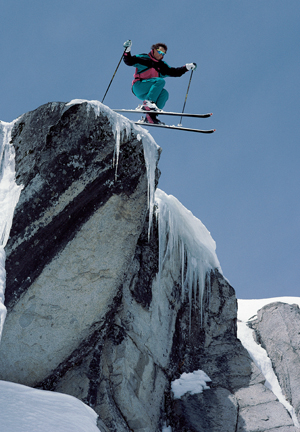
Making decisions is not just about how many costs or benefits there are, however. One cost may outweigh many benefits. Or one benefit may outweigh many costs. Someone might dare you to do something dangerous and even offer you money to do it. The costs of refusing to do it might be that people may laugh at you and that you will not get the money. But you might decide that it is wiser to make a choice to be safe. So perhaps you decide not to take the dare, just because the one benefit (safety) is more important than all the costs. (See figure 4-10.)
Sometimes making a decision to solve one problem can create a different problem. For example, after cars were invented, people could get from one place to another more quickly. But people were getting into car crashes. Over the years, designers have made many changes to cars to help lower the number of crashes, reduce injuries, and prevent damage. Think of some of the technologies that have been developed to improve safety—traffic lights, lane markers, seat belts, child safety seats, rearview mirrors, better brakes, better bumpers, air bags, turn signals, and so forth. You can probably even think of more. How many decisions would designers make when they were developing just one of these safety solutions?
When you are making a decision, you usually have several options. Therefore, when you are making a decision, get as much information as you can. Imagine what the results of your decision would be, and then list the benefits and the costs. Finally, make the best decision you can.
Need to Know: The Model House Contest
You are designing a model house made of wood for a contest. You were supposed to finish it last night, but did not. The contest is this morning at school. To make matters worse, your bottle of glue has dried up. In a kitchen drawer, you find a tube of glue that your brother used on his model airplane. It worked well on the model airplane, but the directions have rubbed off, so you do not have as much information about the glue as you would like. Also, your brother is not home, so you cannot ask him if you may use the glue. But you must finish your house. Which options do you have for making a decision? What are the benefits and costs that may result from each option?
Activity Overview
Before You Teach
Materials
For each student:
- pens or pencils of different colors
As You Teach
Outcomes and Indicators of Success
By the end of this activity, students will understand that making decisions is part of technological problem solving.
They will demonstrate their understanding by
- describing examples of decisions they made while they constructed the model house
- identifying costs and benefits that have influenced past decisions
- explaining the role of a cost-benefit analysis during decision making.
Strategies
Getting Started
Have students read the chapter organizer. They should read the linking question, which helps them make the connection between the Explore activity and this activity, although they will not be able to answer the question until they complete this activity. They should also read the key idea of this activity.
Process and Procedure
Begin the activity by asking students to reflect on the model house they built in the Explore activity. They should reflect on the choices they made when designing their team’s paper house and why they made those choices.
In this step, students consider how the design of the paper house model would be different if they could use any material they wanted and if they were not limited to a certain number of tokens. They should list two to three examples of how the design might have been different if they had access to any materials, and in unlimited quantities.
Have students read Decisions, Decisions, which is about benefits and risks associated with decisions. In this reading, they will learn that most decisions balance benefits and risks (costs). Have them add the bold words or any word that is unfamiliar to them to their personal glossaries. If they need more information about developing a personal glossary, have them read How to Develop a Personal Glossary. The teacher version of How to Develop a Personal Glossary can be found at this link.
Have students read the short scenario The Model House Contest and analyze the benefits and costs that the scenario presents. They should work individually at this point.
After students have read the scenario and thought about the benefits and costs, they will work alone to record their ideas. They should use a different-colored pen or pencil to make additions or changes to their summary tables. A few examples of decisions, benefits, and costs are shown in Figure T4-3.
- After discussing possible decisions with teammates, students should identify which decision they think would be the best in this scenario, and which decision would be the worst.