





Work by yourself to answer the following questions. Record your answers in your technology notebook.
-
Answer the following questions about the convection box:
- How did the smoke help you observe what the air was doing?
- If you could stand inside the convection box, which tube would you stand under to feel the air sinking down on you? Would it be the one with the candle below it or the one without the candle? (See figure 1-5.)
- Where would you have to stand inside the box to feel the air rising upward?
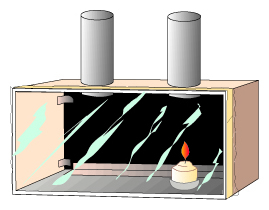 Figure 1-5: Convection box.
 -
Scientists might not use a convection box like this one, but it is still a technology. How did using the convection box help you solve a problem?
-
Would you find rising air above a warm area of Earth’s surface or above a cool area? Hint
-
If you were outdoors, what would you call the moving air?
Answers to Reflect and Connect
Answers to Reflect and Connect
Allow students time to answer these questions. Once they have had time to complete their responses, you may want to hold a class discussion on some or all of them.
Answer the following questions about the convection box:
How did the smoke help you observe what the air was doing?
If you could stand inside the convection box, which tube would you stand under to feel the air sinking down on you? Would it be the one with the candle below it or the one without the candle? (See figure 1-5.)
Which tube would you stand under to feel the air rising upward?
The smoke allowed students to track the movements of the air.
If students could feel air sinking down on them, they would be standing under the tube without the candle.
To feel air rising upward, students would have to stand above or nearby the candle.
Scientists might not use a convection box like this one, but it is still a technology. How did using the convection box help you solve a problem?
Would you find rising air above a warm area of Earth’s surface or above a cool area?
If you were outdoors, what would you call the moving air?
Students should remember from the "Doing Technology" chapter that a technology is anything that helps solve a problem. The convection box allowed them to track the movements of the air so they could understand how it moves in warm and cool areas.
Students should relate this question to their work with the convection boxes. In the boxes, the air rose above the candles. The same would apply to Earth. That means students would find air rising above a warm area.
The moving air is called wind. If you hold a class discussion about this question, note that we feel moving air as it moves across Earth’s surface (lateral movements). By looking at features such as rising and growing clouds, however, we can see that air also can move vertically in the atmosphere.