



Work by yourself to answer the following questions. Write your answers in your technology notebook.
-
Refer back to the focus question you answered in Step 1 of this activity. Now that you have completed the activity, write a new answer to the question. Include all the information you have.
-
Imagine you are designing a house or an apartment building. One of your tasks is to determine where to place the air-conditioning vents. Use what you have learned about air movements to decide whether air-conditioning vents should be placed high on a wall or on (or near) the floor. Explain your answer.
-
Think about wet clothes hanging on a clothesline or a shower rod. After a few hours, they will be dry.
- Will the clothes be dry because of evaporation or condensation?
- Why would a clothes dryer dry clothes faster than hanging them on the line? Use the word energy in your answer.
- Where will the water be once it is no longer in the clothes?
-
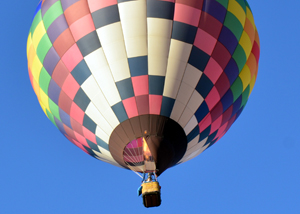
Pilots of hot air balloons use burners (a type of technology) to warm the air inside their balloons. (See figure 1-13.) They turn the burners on and off periodically. Why does the use of these burners enable the pilots to control how high they rise in the air?
-
Work with your teammates to draw a concept map with the following words. On the connecting lines, write words or phrases that explain how the different words are related.
- Temperature
- Pressure
- Density
- Energy
- Elevation
- Wind
- Sun
Answers to Reflect and Connect
Allow students time to answer these questions. Once they have had time to complete their responses, you may want to hold a class discussion on some or all of them.
Refer back to the focus question you answered in Step 1 of this activity. Now that you have completed the activity, write a new answer to the question. Include all the information you have.
Imagine you are designing a house or apartment building. One of your tasks is to determine where to place the air-conditioning vents. Use what you have learned about air movements to decide whether air-conditioning vents should be placed high on a wall or on (or near) the floor. Explain your answer.
Think about wet clothes hanging on a clothesline or a shower rod. After a few hours, they will be dry.
Will the clothes be dry because of evaporation or condensation?
Why would a clothes dryer dry clothes faster than hanging them on the line? Use the word energy in your answer.
The clothes dryer would dry the clothes faster because there is more thermal energy. Thermal energy causes the water in the clothes to evaporate, and a dryer heats up more than clothes hanging on a line do.
Where will the water be once it is no longer in the clothes?
The clothes will be dry because of evaporation.
The water that has evaporated will be in the air in the form of invisible vapor. Make sure students do not think that the water will immediately form clouds or a nearby body of water.
Pilots of hot air balloons use burners (a type of technology) to warm the air inside their balloons. (See figure 1-13.) They turn the burners on and off periodically. Why does the use of these burners enable the pilots to control how high they rise in the air?
Work with your teammates to draw a concept map with the following words. On the connecting lines, write words or phrases that explain how the different words are related.
- Temperature
- Pressure
- Density
- Energy
- Elevation
- Wind
- Sun
Teams will come up with different representations for this concept map. It is important that they understand how these ideas are connected. They should make sure that they show relationships between the words on their concept maps. Emphasize to students that there is no one “right” answer to this task.
At this point, students should be able to write about the movements of water and the water cycle causing rain. They should also understand that the movements of air cause wind. Both of these cycles are related to thermal energy. Decide how much detail you would like your students to include in their answers. They might also talk about density and convection as part of their answers. Remind students that a picture might help them explain some of their ideas, but that they should be sure to label the picture so it is clear.
If students understand the relationship between temperature and air movements, they might recommend placing vents for air conditioning near the ceiling so that the cold air would move downward or they might argue that it would be better to put the vents near the floor because the cooler air would remain there, and force the warm air up. The specific strategy a student chooses is less important than the logic used to justify his or her recommendation.
Pilots of hot air balloons know that warm air is less dense, so it rises. Cooler air is more dense, so it sinks. By using the burner to warm or cool the air inside the balloon, a pilot can make the air inside the balloon either warmer or cooler. If the air inside the balloon is warmer (less dense) than the air outside the balloon, the balloon will rise. If the pilot turns the burner off for a period of time, the air inside the balloon will cool. As the air inside the balloon cools, it becomes more dense. The balloon will descend until the density of the air inside the balloon matches the density of the air outside the balloon. By warming or cooling the air inside the balloon, the pilot can control how high the balloon flies.