






Have you ever tried to build something? Maybe you built something big, such as a fort in your backyard. Maybe you were building something smaller, such as a tower made of blocks. (See figure 2-4.) You probably could have built your fort or block tower in many different ways. Like the products in the Engage activity, there are different designs for a fort or a block tower. What limits those designs?
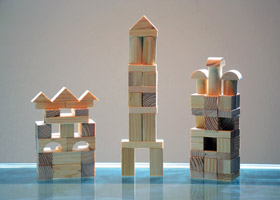
In this Explore activity, Designing with Shapes, you will design objects using different shapes as your building blocks. You will compare your designs with those of other teams. Finally, you will think about what factors increased and decreased the amount of diversity among the designs. Materials
Remind yourself of the focus question for this chapter. It should be written down in your technology notebook in the Engage activity section with a colored box drawn around it. Read the question and the answers you wrote. Add any new answers in a different color.
Obtain the materials you need for this activity. Hint
Design a work of art. To do this, follow Steps 3a–3d. Hint
- Use only one set of shapes.
- You must use all 7 shapes. You may not use more than 7 shapes.
- Arrange the shapes in a design that is attractive to all team members.
- Use a large sheet of paper as the background for your design.
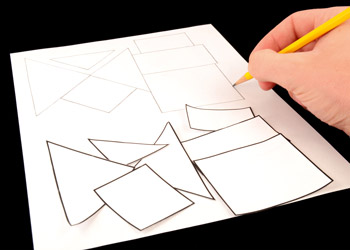
Once you are satisfied with your design, use markers or felt-tip pens to trace the design onto your large sheet of paper. Be sure to trace the outline of each shape, even if some shapes are close together in your design, as in figure 2-5.
Use the same 7 shapes and a new sheet of paper to design a living room. The shapes should represent the furniture in the living room. Keep your design two-dimensional, or flat, on the sheet of paper. Hint
Make sure all team members agree on the design for your living room. Trace the shapes onto the sheet of paper.
Post your papers around the room as your teacher directs.
So far in this activity, you have created two designs to meet particular criteria. One design met the criterion of being an attractive work of art. The other design met the criterion of representing a living room of furniture. Compare your team’s designs for the different criteria with the designs of other teams. With your team, answer the questions in Steps 8a–8c. Write your own answers in your technology notebook.
- Which designs look the most similar to each other—art or furniture?
- Which designs look the most different from each other—art or furniture?
- What do you think led to the diversity among the designs for your answer in Step 8b?
Repeat Steps 3–7. This time, use two sets of shapes for each design. You must use all fourteen shapes in your art and furniture designs. Hint
The first two times you created designs, you had the constraint of using only 7 shapes in the designs. The next two times you created designs, you had a different constraint of using 14 shapes to create the designs. Answer the questions in Steps 10a–10c to help you consider the effects of these constraints. You may work with your team, but write your own answers in your technology notebook.
- Was there more diversity among the 7-shape art designs or the 14-shape art designs? Why? Hint
- Was there more diversity among the 7-shape furniture designs or the 14-shape furniture designs? Why?
- Was there more diversity among the 14-shape art designs or the 14-shape furniture designs? Why?
Activity Overview
In this Explore activity, Designing with Shapes, students will use sets of shapes to make designs. They first will use 7 shapes to create a work of art and a representation of a room of furniture. This part of the activity helps them understand that different criteria—the different purposes for the items—affect the diversity of designs. They then will use 14 shapes to create a new work of art and a new representation of a room of furniture. By designing the same item with different numbers of shapes, students will see that constraints affect the diversity of designs.
Before You Teach
Materials
For each class of 30 students, teams of 3:
- 20 sets of shapes (see Advance Preparation)
- 20 bags or paper clips
- 40 large sheets of paper or butcher paper
- markers or felt-tip pens
- pens or pencils of different colors
- 4 sheets of paper for signs
- tape or tacks
- sticky notes (optional)
Advance Preparation
Make 20 copies of Master 2-1, Shape Sets, on card stock or other heavy paper. Cut out each shape. One copy makes one set of 7 shapes. Keep sets separated by putting them in bags or clipping them together with a paper clip. The sets of shapes can be reused if you have more than one class. Students will trace around the shapes, so if you choose to laminate the shapes, trim the edges closely so students are able to trace them easily.
Make four signs to designate areas around the room. There should be a sign for each of the following:
- 7-shape art designs
- 7-shape furniture designs
- 14-shape art designs
- 14-shape furniture designs.
Use tape or a tack to hang the signs in areas around the room. Allow enough space for teams to hang their designs near the appropriate sign.
As You Teach
Outcomes and Indicators of Success
By the end of this activity, students will
-
become aware that criteria affect the diversity of designs for a product.
They will show their awareness by
- determining which of the products they design show the most diversity
- describing the relationship between product diversity and the number of criteria used in the design of a product.
-
become aware that constraints affect the diversity of designs for a product.
They will show their awareness by
- determining which of the products they design show the most diversity
- describing the relationship between product diversity and the number of constraints used in the design of a product.
Strategies
Getting Started
Have students look at the chapter organizer and read the key idea for this activity. Then, have students read the introduction to the activity. Allow them to discuss something that they tried to build, such as the fort and block tower listed in the introduction, and what helped them make decisions about their designs. They may say that they had only enough materials for one kind of design or they did not have enough space to build what they wanted. Encourage as many ideas as possible.
Process and Procedure
Have students refer back at the focus question for the chapter. In Step 1 of the Engage activity, they wrote down this question in their technology notebooks. There should be a colored box around the question. Having students refer back to the question in their technology notebooks encourages them to use their technology notebooks and to take responsibility for the information in them.
Students should send one team member to retrieve the materials they will need for the activity.
In Step 3, have students design a work of art using one set of shapes. Having the item be a work of art is a criterion for the design. This means that students should use only 7 shapes for the design. They must use no more and no less than the 7 shapes of one set. They should use a large piece of paper for the design and arrange the shapes in a way that is attractive to all three team members. Have students read the hint about the teamwork skill of seeing other people’s points of view, which they should practice during this activity. Then, allow them some time to design the work of art. You might tell them that they are working under another constraint for this activity, a time constraint. Tell them how much time they will have to create the work of art or how long they will have to complete the tasks through Step 7. It is important that teams not influence other teams’ ideas, so have each team keep its work private at this point. If teams start to share their ideas, it may limit the amount of diversity among the designs.
Once students have agreed on the design, they should trace the design onto the piece of paper. They should trace each shape, even if some shapes are touching each other. You should warn them to try to trace carefully, as they will be reusing the shapes. You may also be using the shapes for classes later in the day, so it is important that they try to keep the shapes clean and unbent.
In Step 5, students should use the same set of shapes with a new piece of paper to represent the furniture in a living room. Be sure students read the hint, as it will help them understand how the shapes might represent furniture.
Have students again trace the shapes onto the paper once they all agree on a design.
For this step, point out the designated areas for the 7-shape art designs and the 7-shape furniture designs (see Advance Preparations). Keeping designs with the same criteria together will help students compare the diversity in later steps. Have students post the papers in the appropriate areas of the classroom.
Have students compare the 7-shape designs from the different teams by answering Questions 8a–8c in their technology notebooks.
Students should repeat Steps 3–7, this time using two sets of shapes, or 14 shapes. They must use all the shapes to create another work of art and another representation of furniture in a room. Remind students of the hint that describes how they can use more than one shape to represent a piece of furniture and that they can include items such as lamps and televisions in their living rooms. They should again trace the designs and post them in the appropriate places in the classroom.
Students should answer Questions 10a–10c to help them compare which designs showed more diversity and why. They should notice that there is more diversity when they have more shapes. The number of shapes is a constraint, and when students have fewer shapes, they have fewer options to be creative. Students should also realize that there was more diversity with the 14-shape art design than with the 14-shape furniture design. The purposes of these two designs were different. With a criterion of being attractive, students were able to be fairly creative in their art designs. When they had a more specific criterion of representing furniture, there was likely less diversity in what they were able to create.