







You may have noticed that airplanes come in many shapes and sizes, like those in figure 2-6. You might have been to an airport or an air show. Maybe you watched programs on television that showed different kinds of airplanes. If you looked closely, you might even have been able to tell the difference between airplanes as they were flying. Why do you think there is such a great diversity among airplanes? It has something to do with criteria and constraints.

In this Explain activity, Ideas That Fly, you will learn about how criteria and constraints affect designs. You will be working in teams to design paper airplanes. You will use certain criteria and constraints as you design the airplanes. When you are finished, you will compare your team’s design with other teams’ designs. Materials
Read the criteria and constraints for each design plan.
By yourself, make a prediction about which set of criteria and constraints will lead to the most diversity in the class designs. Make a prediction about which set will lead to the least diversity in the class designs. Explain your predictions. Hint
Share your predictions with the class.
Work with your team to complete the tasks in Steps 4a–4c.
- Design each type of airplane from the sets of criteria and constraints.
- Write the number of the design and your names on each airplane.
- Make sure that each team member can explain how each airplane meets the criteria and constraints listed for its design. Hint
-
Follow your teacher’s instructions to participate in the demonstration of the designs. Hint
 Caution! Wear your safety goggles and follow your teacher’s instructions as you fly the airplane.
 Examine each of the airplanes that met the criteria and constraints. Determine which design plans had the most diversity and which had the least diversity.
Describe whether your predictions were correct. Work by yourself on this step. Based on what you have done in this activity and the Explore activity, try to come up with a “rule” about what leads to more diversity in designs. Hint
Create a two-column table in your technology notebook with the headings “leads to more diversity” and “leads to less diversity.” To help you think about what leads to diversity, read Similarity and Diversity in Designs. As you read, complete your table with items that lead to more or less diversity.
-
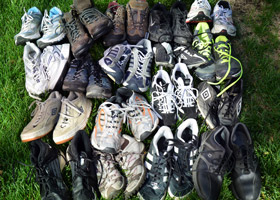 Figure 2-7: Athletic shoes show a lot of diversity. All these shoes are athletic shoes, but there is a lot of diversity in their designs. Why do you think there are so many differences?
Similarity and Diversity in Designs
Think about a shelf full of books. Although there would be some diversity in their designs, they would probably be pretty similar. All the books would have a cover and pages inside. They would all have print on the inside, and probably on the outside, too. Why do you think books have so many similarities?
There are other products that look very different from one another. Think about athletic shoes. If you went into a store that only had soccer shoes, a lot of them would look the same. There might be different brands and colors, but they would all have the same basic shape and features. What if the store carried all types of athletic shoes? Basketball shoes look different than running shoes. Baseball cleats look different than tennis shoes. Yet we think of all of them as types of athletic shoes, as in figure 2-7. Why do you think athletic shoes have so many differences?
What is it about engineers and the design process that leads to more or less diversity in designs? Engineers start with the function, or purpose, of their products. If that function is very specific, then different designs for that product will all be very similar. Describing the function of the product is the same as listing criteria for it. A product may have specific criteria for its design. This means that other designs with the same criteria will look similar.
Think back to the Explore activity. When you designed your art, the function was not very specific. Although art has a purpose, your criterion was that it had to be attractive. Your class probably had a lot of diversity in its art designs. When you designed the room of furniture, there was a more specific purpose. Although you could use some creativity, in the end you had to have something to sit on and maybe a table or two. Your furniture designs were probably a lot more similar to those of your classmates.
-
 Figure 2-8: An SUV. If you had to design a vehicle that could hold several people and their suitcases, it would probably look something like this.
What if you were designing cars? The only criterion would be that you have to design a vehicle. There would be a lot of different designs. What if there were more criteria? Maybe the car would have to hold six people and six suitcases. These are more specific criteria, and they would lead to less diversity in the designs. It is more likely that all the designs would look like minivans or SUVs. (See figure 2-8.)
One short statement makes this point clear: Criteria limit the diversity of designs. When there were more criteria for the car design, the engineers had fewer choices to make. The more criteria there are for a design, the less creative the designer can be.
Criteria are not the only thing you and other engineers have to consider when you are designing a product. Constraints affect the final product, too. Hint
One constraint is materials. Think again about the Explore activity. You probably saw that the more shapes you were allowed to use, the more creative you could be. There was more diversity when you had 14 shapes to use. Having only 7 shapes limited your materials, so fewer shapes was a design constraint. You had to be less creative, so there was less diversity in the designs.
Making decisions involves creativity. The more choices you can make for your product, the more creative you can be in the design. When you have fewer choices, your creativity is limited. Then, your design is more likely to look like someone else’s design that has the same purpose.
-
Share the items you listed in your table with your teammates. Revise the rule that you created in Step 7. Use a different-colored pen or pencil for your revisions.
Based on what you have learned, work with your team to revise your design plans using Steps 10a–10b. Write your revised plans on a large sheet of paper.
- Choose a design plan from those listed. Change one criterion or one constraint in a way that you think will decrease diversity among the designs.
- Choose a design plan from those listed. It can be the same as, or different from, the design plan in Step 10a. Change one criterion or one constraint in a way that you think will increase diversity among the designs. Hint
- Present or share your work as the teacher directs.
In Similarity and Diversity in Designs, you read that criteria and constraints limit (decrease) the diversity of designs. In Step 10, you changed a criterion or constraint to increase or decrease diversity. What is different between the two situations?
Use what you have learned to revise your answer to Reflect and Connect Question 5 in the Explore activity.
Activity Overview
In this Explain activity, Ideas That Fly, students will use criteria and constraints to examine the amount of diversity in paper airplane designs. They will read about how criteria and constraints limit the amount of diversity in a design. They then will set up their own criteria and constraints for a new airplane design.
Before You Teach
Background Information
Criteria and constraints limit the amount of diversity in a product design. If a designer has no limits on the design, then there can be a great deal of diversity among different designs. Once criteria and constraints are introduced, the amount of diversity begins to decrease. It is important to realize that when criteria and constraints change, the amount of diversity changes as well. Depending on how the criteria and constraints changed, the amount of diversity in designs might increase; however, there will still be less diversity than there would have been with no criteria and constraints.
Materials
For the entire class
- 1 roll of masking tape
- 1 roll of transparent tape
- 8 copies of Master 2-2, The Process of Technology Design cut into fourths
- 30 copies of Master 2-3, Design Plans (optional—may be projected or viewed on a computer screen)
- glue sticks (optional)
- 3 sheets of paper for signs
- tape or tacks
For each team of 3 students:
- 10 sheets of 8½” × 11” paper
- 2 paper clips
- 1 meterstick or metric measuring tape
- 3 pairs of safety goggles
- 1 large sheet of paper or butcher paper
- additional materials, such as glue, rubber bands, and paper clips
- pens or pencils of different colors
- markers or felt-tip pens
Advance Preparation
Make 8 copies of Master 2-2, The Process of Technology Design. Cut each copy into fourths to be distributed during Reflect and Connect Question 5. You may also wish to provide copies of Master 2-3, Design Plans. This master is shown as a reference in Steps 1 and 10 in the Student Edition, so students may view it as a PDF online or you may choose to project it.
You may also wish to make signs for Step 6. These signs should read, “Design Plan 1,” “Design Plan 2,” and “Design Plan 3.” They should be posted in areas around the room to show students where to put their completed airplanes.
Cautions
The students will test flying paper airplanes in this activity. Establish these rules for flying the airplanes:
- Wear eye protection such as safety goggles.
- Do not aim airplanes at anyone.
- Keep track of the flight path of your own airplane so that you can warn anyone it might hit.
- You cannot participate in flight contests if you are not in the class launching line (described in Steps 4–5).
Add to these rules as necessary based on your students, classroom, and school.
As You Teach
Outcomes and Indicators of Success
By the end of this activity, students will
-
understand that having criteria and constraints limits the amount of diversity among designs.
They will demonstrate their understanding by
- predicting which design plan for paper airplanes will lead to the most diversity
- verifying their predictions about the diversity of paper airplane designs
- designing airplanes with varying numbers and degrees of criteria and constraints
- determining a “rule” about what leads to more diversity in designs.
-
understand that changing criteria and constraints changes the amount of diversity in designs.
They will demonstrate their understanding by
- revising design plans to create more or less diversity among designs
- writing a paragraph to reflect on what happens to diversity when criteria and constraints change.
Strategies
Getting Started
Remind students of their designs for the art and furniture in the Explore activity. Have them look at the chapter organizer and read the key idea for the Explore activity, the linking question that leads to the Explain activity, and the key idea for the Explain activity. Have them read the introduction to the Explain activity. Then, hold a brief class discussion about why they think there is such a great diversity of airplane designs.
Process and Procedure
-
Have students read each of the three design plans for the airplanes.
-
Students should work individually to predict which sets of design criteria and constraints they think will lead to the most and the least diversity among the airplane designs. They should explain the reasoning behind their predictions. The information in the hint reminds them of their work in the Explore activity to help them think about their predictions and explanations.
-
Have a brief class discussion to talk about the predictions. Do not tell students which of the design plans will lead to the most diversity at this point; rather, have them share their ideas and reasoning. They will check their predictions through experimentation. Whether or not their predictions are correct is not as important as how they justify them. For your information, design plan 3 should lead to the greatest diversity because the criteria are not as specific as in the other designs. The term “acrobatic” is open ended and subject to many interpretations. Design plan 2 is the least open ended. With more specific criteria, creativity is diminished and product diversity decreases.
-
In Step 4, students should work as a team to design the airplanes. Many students’ processes will involve testing and modifying their designs, so be sure they adhere to the rules in the Cautions section above. Testing prototypes is an important part of the design process, and you should encourage it. Clear a large space for testing. Be sure to have both a 3- and a 4-meter section marked off with masking tape so that students are able to test their airplanes for design plans 1 and 2. Also, ensure that all students in the testing area are wearing eye protection. Once students are satisfied with their designs, have them put their names on each airplane. In Step 4c, students should make sure that each member of their team can explain the design of the airplanes, because you will choose one student to explain and launch the airplanes in Step 5. Emphasize the information in the hint. Students must ensure that all teammates will be able to explain the team’s designs.
-
In Step 5, hold a flying contest so students can determine whether their predictions were correct. Project or post Master 2-3, Design Plans, which shows the criteria and constraints for the first design. For the contest, have the students stand in a launching line, in which they line up side by side so that no student is behind or in front of any other as they fly their airplanes. Choose one student from the team to explain how the design meets the criteria and constraints. Then, have the student launch the airplane. You may want to have all of the chosen students launch their airplanes at the same time. Doing so will make it difficult to determine that each airplane meets the different criteria and will require more space, but it will take less time. It may be easier to have one launch for design plan 1 airplanes, a second launch for design plan 2 airplanes, and a third launch for design plan 3 airplanes. If you do this, any students who are not involved in a given launch should stand well away from the launch line and flying area. During the launch, you should pay careful attention to which airplanes meet all the criteria for the appropriate design plan. Any airplane that does not meet the criteria and constraints should not be considered in Step 6.
-
Have students put any airplanes that met all the criteria and constraints for a given design plan into one area. You may wish to have signs showing the different areas for the different design plans. Allow students to do a gallery walk to determine which design plans led to the most and the least diversity among the designs.
-
In Step 7, students should work individually to determine whether their predictions were correct. They should then try to come up with a “rule” about what leads to more diversity in designs. For example, they might talk about the number of criteria and constraints or the specificity of the criteria and constraints, based on their work in this activity and in the Explore activity. Creating a rule serves as the pre-reading strategy. If students seem to be having trouble, the information in the hint may help.
-
Students should create a two-column table as described in Step 8. This table will be used as a during-reading strategy. Once students have the tables prepared, they should read Similarity and Diversity in Designs. Make sure that they are completing their tables as they read. Writing down ideas about what leads to more diversity or less diversity helps students focus on the important information in the reading.
-
Give teams time to talk about what they wrote in their tables. Tell them that they are free to add new information that they find out from their teammates, but that any new or revised information should be written with a different-colored pen or pencil. This helps students keep track of their learning and see how their learning progresses.
-
In Step 10, students should make two revisions of the design plans. They should choose one design plan to revise for Step 10a. In that step, they should change one criterion or constraint to try to decrease diversity among the designs. In Step 10b, they should revise either the same or a different design plan by changing one criterion or constraint in an effort to increase diversity among the designs. The information in the hint is very important in helping students recognize one criterion or one constraint. Students may wish to include additional materials, such as more paper clips, sticky notes, or rubber bands, in their revised designs. Use your discretion as to whether they can include the materials. Step 10c allows you to decide how to continue with this activity. If you are short on time, you can simply have students turn in their revisions to the design plans. If you have more time, you can have students test their designs. As a class, decide on which design for Step 10a is likely to generate the least diversity and which design for Step 10b is likely to generate the most diversity. You might have students post their revisions on a large sheet of paper or butcher paper to allow others to see the choices. Students, or teams of students, should then create an airplane for each of the two revised plans that the class chose. Making the airplanes could be done as a homework assignment. If you continue with this part of the activity, hold an additional launch for the two designs and compare the amount of diversity among the planes that met the criteria.
-
In Step 11, students should write a paragraph to reflect on whether criteria and constraints always limit diversity. Have them work individually and quietly for some time. They may then work in their teams once they have had a chance to write their initial ideas. The point of this question is for students to realize that any criteria and constraints will limit designs when compared to having no criteria and constraints. However, when criteria and constraints change, diversity may increase or decrease. This is another opportunity for a formative assessment. Students should begin to understand the idea that changing criteria and constraints changes the amount of diversity.
-
Give students time to revise their answers to Reflect and Connect Question 5 in the Explore activity. Remind them to provide the most complete answer they can, so even if they did not change their ideas, they likely have learned additional information that they can add to their answers.