





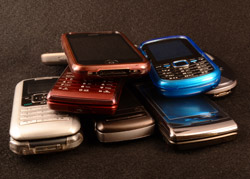
How many ways can you think of to hold papers together? How many ways can you think of to hold a ponytail in place? What about the number of ways to open a bottle? There are many different solutions that can help us do each of these tasks. In this Engage activity, One Problem, Different Designs, you will analyze different products that are designed to do the same thing. You can see an example of this idea in figure 2-1. Materials
In your technology notebook, write down the focus question that was asked in the second paragraph of the chapter introduction. Draw a colored box around the question. Then, write your answer to the question. Hint
Look at the items that your teacher has displayed. What is the purpose of each product? Hint
In your technology notebook, draw a Venn diagram like the one in figure 2-2. Fill in the blanks with the names or descriptions of the three products.
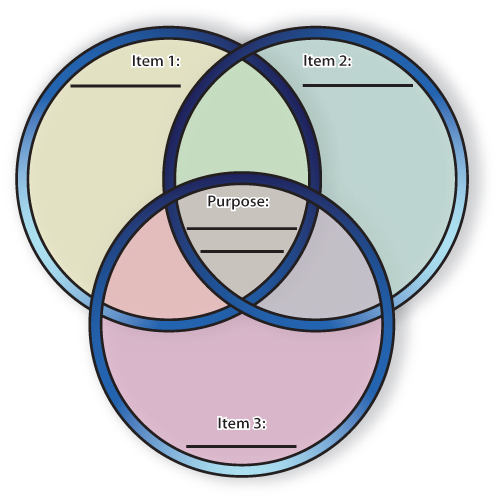 Figure 2-2: A Venn diagram to compare three products. Draw a Venn diagram like this one. Be sure to fill in the blanks with the names of the products.
Write the purpose of the products in the center of the Venn diagram. The purpose should be the same for all three products. Hint
Complete the rest of the Venn diagram by following Steps 5a–5b.
- What properties are different between the three designs? Write the properties that only apply to one product in the outer part of the circle for that product (where there is no overlap with any other circle). List at least two unique properties for each product.
- What properties are similar between at least two of the products? Write the properties that are similar in the overlapping spaces. List at least one property in each overlapping space.
In your technology notebook, answer the following questions:
- What one criterion would be the same for the engineers designing each of these products? Hint
- The engineers probably had other criteria for their designs. Some of these criteria may have applied to only one or two of the designs. What do you think some of these other criteria might have been?
- What are some of the constraints that you think the engineers had to work around when they were designing these products?
Activity Overview
In the Engage activity, One Problem, Different Designs, students will think about why there are so many different products that have the same purpose. They will look at examples of different designs for a product and create a Venn diagram of the similarities and differences between the designs.
Before You Teach
Background Information
The background information presented here will be helpful through the rest of the chapter. The process of design naturally leads to a diversity of products. Designers need to make many decisions when designing products, and each decision presents an opportunity for developing a unique product. Design criteria and constraints, however, limit the diversity of products.
Given a common goal, only a limited diversity of products will accomplish the goal. For example, telephones come in a wide variety of designs, but the fact that they must function as telephones limits how diverse the designs can be. When there are more stringent constraints, a designer has fewer options in making a decision about the final product. For example, suppose a designer of office furniture wants to make a new kind of desk. The only affordable materials, however, are plastic and steel. Because the materials are limited, the design may be limited.
We can summarize how the process of technological problem solving affects the diversity of products with the following statement: Criteria and constraints limit the diversity of designs.
Materials
For the entire class:
- products with the same purpose but different designs (see Advance Preparation)
- pens or pencils of different colors
Advance Preparation
Obtain at least three products that have the same purpose but different designs. You will demonstrate these three products for this activity. Possibilities include hairbrushes, calculators, watches, telephones, or other objects that interest you. We do not recommend that you use cell phones, as some students might consider them to have more than one purpose. For example, many of today’s smartphones allow you to check e-mail, access the Internet, send text messages, and play games in addition to making phone calls.
If you have not already begun to prepare for the Explore activity, read Advance Preparation for that activity. Begin preparing the sets of shapes in advance.
 Cautions
If you demonstrate electrical or heat-producing products, be sure that students keep a safe distance from them if they are operating. Consider taping cords down so students do not trip on them.
As You Teach
Outcomes and Indicators of Success
By the end of this activity, students will
-
become interested in the idea that products with similar purposes can have a variety of designs.
They will show their interest by
- describing their ideas about why there are so many products that do the same thing
- listing and describing two additional products that do the same thing but have different designs.
-
practice completing a Venn diagram.
They will show their ability by using a Venn diagram to compare and contrast products with the same purpose.
Strategies
Getting Started
Begin the chapter by going over the chapter organizer with students. Students should read the key ideas of the activities as well as the linking questions. Then, have them read the introduction to this activity. Pose each of the questions in the introduction to them and allow them some time to discuss their ideas with their teams.
For this chapter, it is important that students understand the meaning of the word diversity. As you get started, have students read the title of the chapter, “Diversity in Technology,” and ask them what they think it means. They may have heard the word diversity before, but not as it relates to designs. Before you move on, make sure that they understand that the word diversity means that there is a range of differences or variety.
Process and Procedure
Have students look at the focus question at the end of the chapter introduction (“Why are there so many products that do the same thing?”). Make sure they understand that a focus question is one that will help them keep their minds on what they should be learning in the chapter. They should write down the question in their technology notebooks, and then draw a colored box around it. This will help focus their attention on the question. They should also write down their best answers to the question. Reassure them that you do not expect them to know the correct answer at this point in the 5E Instructional Model. Be sure to have them read the hint that instructs them to leave several blank lines under their answers so they can add more information later.
Display the items you have chosen that have the same purpose but different designs. Make sure students read the hint, and then have them think about the purpose of the items. If they seem to be coming up with a purpose for each item, rather than a single common purpose, remind them of the hint.
Have students draw in their technology notebooks a Venn diagram like the one shown in figure 2-2 in the Student Edition. Then, have them write the names or a description of the three items in the blanks. You might have them use brand names, colors, or some other feature to distinguish the items from one another. For example, they might describe the products as a red hairbrush, a blue hairbrush, and a purple hairbrush.
Students should write the purpose they came up with in Step 2 in the middle of the Venn diagram. If you have never used Venn diagrams in your classroom, take this opportunity to have students go through How to Use and Create Venn Diagrams. The teacher version of How To Use and Create Venn Diagrams provides additional support for this topic. They should understand that they put common features in overlapping areas and list unique features in nonoverlapping areas. Point out that there are some overlapping areas for features that are common to just two of the circles or products and one overlapping area for features that are common to all three circles or products.
Allow students time to complete the rest of the Venn diagram. You may want to help them work through an example if they have not had previous experience with Venn diagrams. Steps 5a–5b will help them complete the diagram.
Students should work by themselves to answer the questions in Steps 6a–6c. Although their answers will vary depending on the products you demonstrated, their one criterion for Step 6a will likely be that the products had to fit the purpose of the design. They should use what they have learned in the previous chapter to come up with other criteria and constraints in Steps 6b–6c.