
By now you should realize that you can use probability to make predictions about all kinds of things. Should you wear a rain jacket to school? What is the chance that someone in your class has the same birthday as you? In this Elaborate investigation, What Will Happen Here?, you will use probability to decide which types of events are most likely to occur at a given location. (See figure 3-11.) Materials
-
Set up your technology notebook for this new activity.
-
Read the Need to Know, Background Information, to prepare you for the rest of the activity.
Need to Know: Background Information
During this investigation, you will read about the probability of certain natural events occurring. As you decide which events will occur at each location, you might find the following information useful:
- Hurricanes mostly affect the land along coastlines. In the United States, hurricanes usually occur in the eastern and southeastern parts of the country.
- Tornadoes may occur almost anywhere in the United States. Refer to your technology notebook for the Elaborate activity, Twisters, in Chapter 2 to refresh your memory about where tornadoes occur most frequently.
- Fires may occur in any location where there is fuel to burn.
- Droughts may occur in any part of the country, although they are usually associated with the western, midwestern, and southwestern parts of the United States.
- Snowstorms may occur almost anywhere in the United States, but they occur much more often in the northern and mountainous parts of the country.
-
Read Master 3-3, Natural Events on the Map. Follow the instructions on the handout. As you work, discuss your opinions with your teammates. Make sure you explain the reasons for your decisions. Hint
-
Participate in the class discussion. Listen as others explain why they think a particular set of events would occur at a certain location.
Activity Overview
The Elaborate activity, What Will Happen Here?, builds on students’ understanding of probability. In this activity, students will consider the probabilities of a number of different natural events that may occur in one location.
Before You Teach
Materials
For each student:
- 1 copy of Master 3-3, Natural Events on the Map
Advance Preparation
Make 1 copy per student of Master 3-3, Natural Events on the Map
As You Teach
Outcomes and Indicators of Success
By the end of this activity, students will
-
understand that certain types of natural events are more likely to occur in certain locations.
They will show their understanding by
- analyzing information about probabilities of different types of events in a specific location
- deciding which locations would experience certain events
- recognizing that higher probabilities of certain events (such as tornadoes) exist in certain locations
- labeling a map to designate the events.
-
be able to recognize the usefulness of probability statements in making decisions.
They will show their recognition by
- justifying their choices based on the probabilities they were given
- describing a decision they made based on a probability statement.
Strategies
Getting Started
Have students look at the chapter organizer and determine what they have learned so far in the chapter. Help them recall what they have learned about probability during the Explain activity. Also, help them remember what they learned in Chapter 2 about different types of natural events and the factors that might play a role in making those natural events more severe. Ask students to read the introductory material at the beginning of this Elaborate activity.
Process and Procedure
-
Allow a few minutes for students to set up their technology notebooks for the new activity.
-
Ask students to read the Need to Know, Background Information.
-
Students will work in teams of three for this activity. Give each student a copy of Master 3-3, Natural Events on the Map. Have students work through the instructions on the handout.
-
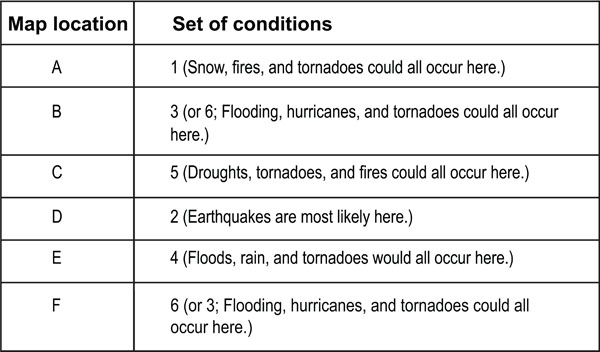
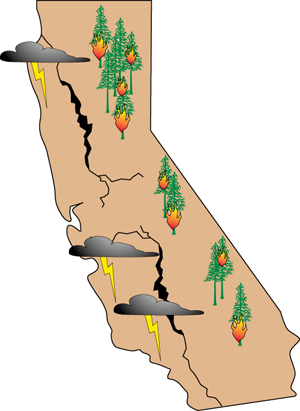
Wrap up the activity by holding a class discussion. Allow teams the opportunity to share their conclusions as well as the reasons for their decisions. Each team should have reasons to support its decisions. Teams may have reached different conclusions for matching events and locations. One reasonable match for locations and events is shown in figure T3-2.