






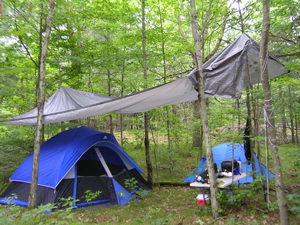
Have you ever made decisions based on what the weather will be? (See figure 3-2.) Maybe you decided what you will wear because it is either cool or hot outside. Maybe you decided not to go on a camping trip because you thought it was going to rain.
In this Engage activity, What Will the Future Be?, you will learn about weather events as they may occur in the future.
-
Set up your technology notebook for a new activity. Remember to include the title of the activity and the date. Add this information to your table of contents.
In your technology notebook, write the words prediction and forecast. Write your ideas about what these words mean. Hint
Join with a partner. Compare your ideas about the meanings of these words. As a team, write a definition that you both agree on for each word. Label these definitions “team definitions.”
Write the definitions that your teacher gives you in your technology notebook. Describe how similar or different these definitions are to your team definitions. Include your ideas about how these words might be used to describe the weather.
-
Read the following statements about the weather. What do you notice about these phrases? Discuss your ideas with your partner and write your ideas in your technology notebook.
- Rain may change to snow.
- A storm is expected.
- There is a chance of rain.
- There is a possibility of 15 to 30 centimeters (6 to 12 inches) of snow.
Activity Overview
The Engage activity, What Will the Future Be?, asks students to consider two words that are commonly used when speaking about weather events. These words, prediction and forecast, relate to events that will happen in the future. They also involve some degree of uncertainty. This activity will prepare students for later activities in this chapter that focus on the chance or probability of different weather-related events occurring.
Before You Teach
Materials
none
As You Teach
Outcomes and Indicators of Success
By the end of this activity, students will be aware that weather predictions or forecasts involve some degree of uncertainty.
They will demonstrate their awareness by
- developing definitions for the words prediction and forecast
- considering how certain words and phrases used in weather forecasts often indicate a chance of certain events happening in the future.
Strategies
Getting Started
Begin by having students read the chapter overview and the goals for the chapter. Go over the chapter organizer with them. They should read the key ideas and the linking questions. Note that the linking questions help them understand the connections between one activity and the next, but that they will not be able to answer a given linking question until they complete the activity that follows the question. Then, have them read the introduction to the Engage activity before beginning the investigation.
Process and Procedure
If necessary, remind students how to set up a new page in their technology notebooks. They should include the title of the activity and the date. They should add this information to the table of contents.
Students should work independently in Step 2 to write their ideas about the meanings of the words prediction and forecast in their technology notebooks. The hint suggests that they think about where they may have heard these terms before. They may get clues about the meanings if they remember where they have heard the words previously.
Ask students to compare their definitions with those of a partner in Step 3.
-
Provide students with the following definitions of the words:
- Prediction: Something that is stated or told in advance, especially on the basis of special knowledge
- Forecast: A statement about what will or may happen in the future
Allow time for students to compare these definitions with the definitions that they and their partners developed.
Note: The definitions provided above are for the noun form of the words. (The verb forms of these words are forecast and predict.) These definitions are relatively general. Students are likely to have used the word prediction when doing scientific investigations. Another definition of prediction is to state something in advance based on observation, experience, or scientific reasoning. For the purpose of this activity, the main point for students to recognize is that both of the words prediction and forecast relate to things that may happen in the future.
Students will consider a few phrases that may be used in a weather prediction or weather forecast. Each phrase includes words that indicate the likelihood of something happening in the future. After students have had a chance to think about these phrases, hold a brief class discussion to ensure that they recognize that a common characteristic of these phrases is that of chance. The phrases do not include absolutes that something will definitely happen in the future.
Although there is some uncertainty associated with the terms prediction and forecast, students should not be left with the impression that a prediction or a forecast is a complete and random guess about what will happen in the future. Scientists rely on observations and other forms of data when they make their predictions, but there are also things that can change. For example, a meteorologist may predict a temperature change. However, if other factors change more quickly or more slowly than expected, the predicted temperature change may not occur at the time expected or to the extent initially predicted.