



Sometimes natural disasters can affect a fairly small area. At other times, they can cause serious damage to hundreds or even thousands of acres of land. They may affect a single community, or they may affect an entire country.
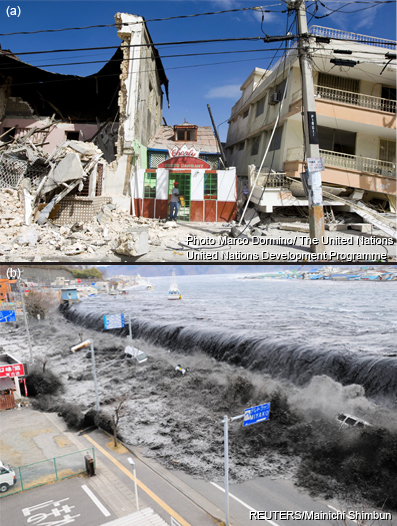
Most natural events do not cause the huge amounts of damage or loss of life that occurred in Haiti and Japan. (See figure 2-11.) But even if a natural event affects a small area or a small number of people, it can still have a great impact. It can be difficult to understand how a single event, large or small, can cause a lot of damage unless you have experienced it yourself. But it is not recommended that you experience a hurricane or tornado in person. Not, that is, if you want to be safe.
In this Explore activity, Miniature Events, you will investigate miniature events that model real-life events. You will think about how these miniature models compare with the real thing. Materials
Gather your team of three students at your first assigned station. Write the station number and name in your technology notebook. Hint
Follow the instruction card for that station.
Observe what happens. Record your observations in your technology notebook and answer any questions that appear on the instruction card for that station. Hint
Move to the other stations when your teacher says it is time. As you work through the stations, practice the teamwork skill of sharing responsibility. This means you should take turns at leading the team through the station.
In your technology notebook, begin an explanation for what you observed at each station, including why the event occurred. In each of your five explanations, record the following:
- Write down the station number and name.
- Explain what you observed at each station and what the final result was.
- Describe what caused whatever you observed to happen.
- Explain how the event compared with a real-life event. Hint
Activity Overview
The Engage activity helped students begin thinking about natural events and natural disasters. In this Explore activity, Miniature Events, students will work through activities at five stations that model aspects of natural events.
Before You Teach
Materials
For the entire class:
- 2 copies of Master 2-1, Station Instruction Cards, cut apart and laminated
- 2 desk lamps (each with a bright lightbulb, 60 or 75 W)
- 4 cups of potting soil
- 4 beakers or cups
- 2 small dishpans
- 4 plastic bottles, 2 L soft-drink type
- 2 sling psychrometers
- 2 sturdy stands (to hold the sling psychrometers)
- 2 cookie sheets
- 2 plastic spray bottles with water
- 2 relative humidity calibration charts (which come with the psychrometers)
- 2 Tornado Tubes
- 2 pitchers of water
- 2 water disposal containers
- 2 small, clear drinking glasses
- 2 large glass jars
- 2 votive candles
- 2 boxes of safety matches
- 6 pairs of safety goggles
- 4 thermometers
- 4 pieces of cardboard (2 for the drought stations, 2 for the hurricane stations)
- 12 sticks of brown modeling clay
- small, plastic toy houses or buildings
- tape
Advance Preparation
Set up 2 stations at each of 5 locations in your classroom. In total, you will have 2 drought stations, 2 flood stations, and so on. Place of copy of the appropriate Station Instruction Card that you have cut out from Master 2-1, Station Instruction Cards, at each station.
Station 1: For each of the 2 fire station setups, obtain 1 small, clear drinking glass and 1 large glass jar. Beakers will not work in this case because they will not form airtight seals. Also, obtain 1 votive candle and a box of safety matches. Set out 3 pairs of safety goggles at each fire station.
Station 2: For each of the 2 drought station setups, use 1 desk lamp with a bright lightbulb, 2 thermometers, a cardboard shade, and 2 beakers or cups of soil. Place a piece of cardboard so that it blocks the light from reaching 1 of the cups of soil. Let the other cup remain under the light. Put thermometers in both cups at each station. Turn on the lamp at least 20 minutes before class.
Station 3: For each of the 2 flood station setups, use the bottom of a dishpan for the riverbed and a thin, flat layer of clay next to the river to represent a floodplain. At a slightly higher layer than the floodplain, construct a small bank or berm to represent a terrace. Use small toys up on the bank to represent buildings or houses. Set up a pitcher of water, as well as a water disposal container at each flood station.
Station 4: For each of the 2 hurricane station setups, be sure that a relative humidity calibration chart came with each psychrometer. Make sure that a copy of the relative humidity calibration chart is available to the students at this station. You may want to laminate this chart and tape it to the table so students will be able to use this information. Hang a sling psychrometer from a sturdy stand. Do not let students swing the psychrometer. To move air past the wet- and dry-bulb thermometers on the psychrometer, students can fan the air with a piece of cardboard for several minutes. Place a spray bottle full of water at each hurricane station so that students can keep the wick of the wet-bulb thermometer wet.
Station 5: For each of the 2 tornado station setups, order a Tornado Tube (or tornado connector) from a science supply company. To build a tornado-in-a-bottle setup, fill 1 of the plastic soft-drink bottles three-quarters full of water. Attach the Tornado Tube. Twist the other bottle onto the other side of the Tornado Tube. Check to make sure no water leaks out.
You may want to do a trial run for some of the stations before students arrive. In particular, you may want to review using the psychrometer and the relative humidity calibration chart. You may also want to test the tornado-in-a-bottle setup so you can help students achieve the best outcomes. The trial run might help you determine how much time to allow students at each station.
 Cautions
Students will be striking matches. Have them use the precautions they took for the Explore activity, Wind in a Box, in Chapter 1. You should also have an ABC tri-class fire extinguisher available. Students should tie long hair back, clear desks, and wear safety goggles. Water in the classroom may lead to spills. Mop up any spills quickly. Remind students to handle thermometers with care.
As You Teach
Outcomes and Indicators of Success
By the end of this activity, students will be aware of key features of several natural events.
-
They will demonstrate their awareness by
- recording their observations of events at five stations
- comparing how the miniature events model actual events
- attempting to describe the natural process that causes each event.
Strategies
Getting Started
Have students look at the chapter organizer.
Process and Procedure
- Inform students that they will be completing tasks at each of five stations. Go through the procedures with them and remind them of any precautions they need to take at each station. Tell them how much time they will be allowed at each station. Explain that they should take a few notes at each station but that they will have more time at the end of the activity to write more complete answers. Assign different stations for teams to complete first. As students work, be sure to circulate around the room to help them with any problems they may have.
- After students have had time at each station, allow time for them to complete their technology notebook entries. They can discuss their ideas with their teammates. After they have had the opportunity to complete their entries, discuss their ideas with the class.