








Work by yourself to complete the following tasks.
-
Read the following scenario, and then answer Questions 1a–f.
Mary wanted to conduct a test related to plants. She used three pots that were the same size. In pot 1, she put brand X soil and three radish seeds. In pot 2, she put brand Y soil and three radish seeds. In pot 3, she put brand Z soil and three radish seeds. She then put each pot on a sunny windowsill and watered the pots every day for three weeks, as in figure 3-7. She added the same amount of water to each plant. At the end of three weeks, she measured how tall the plants were.
Figure 3-7: Mary’s tests. Mary used three pots of soil in her tests. She put them on a windowsill and watered them every day.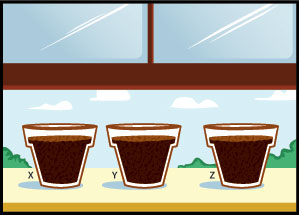
- What was Mary testing?
- What was the independent variable in the test?
- What was the dependent variable in the test?
- What variables did Mary keep constant?
- Did Mary have a control in her test?
- Did Mary run a fair test? Provide evidence for your answer.
-
When a new drug is invented, many tests have to be run before the drug can be sold to people. In some of the tests, half the people receive the drug and half the people receive a placebo. A placebo is a pill or liquid that does not contain any drug. Placebos are harmless.
What is the point of giving some people the placebo? Explain your answer.
-
Why do you think it is so important to ABC Water and Space that its products be tested using fair tests? Hint
-
How did using a checklist help you understand the parts of the test in the Applications master?
Answers to Reflect and Connect
Allow students enough time to work by themselves to answer the questions. Then hold a class discussion about their answers. In particular, Questions 1 and 2 assess their understanding of the different aspects of fair tests, so you can determine their level of understanding about the concept.
-
Read the following scenario, and then answer Questions 1a–f.
Mary wanted to conduct a test related to plants. She used three pots that were the same size. In pot 1, she put brand X soil and three radish seeds. In pot 2, she put brand Y soil and three radish seeds. In pot 3, she put brand Z soil and three radish seeds. She then put each pot on a sunny windowsill and watered the pots every day for three weeks, as in figure 3-7. She added the same amount of water to each plant. At the end of three weeks, she measured how tall the plants were.
-
What was Mary testing?
Questions 1a–f offer a good opportunity to evaluate students’ understanding about fair tests. Mary was testing which type of soil was best to make radish seeds grow.
-
What was the independent variable in the test?
The independent variable was the type of soil. In this case, the type of soil was what Mary changed for each pot.
-
What was the dependent variable in the test?
The dependent variable was the height of the plants at the end of three weeks. The height “depended on” the type of soil that was used.
-
What variables did Mary keep constant?
The variables that Mary kept constant include the number of seeds, the type of seed, the amount of sun the plants received, and the amount of water each plant received.
-
Did Mary have a control in her test?
No, there was no control in this experiment.
-
Did Mary run a fair test? Provide evidence for your answer.
Mary did not run a completely fair test, although her experiment featured some aspects of a fair test. She had a dependent variable and an independent variable, and she only changed one variable and kept the others constant. True, there was no control, but make sure students understand that they do not necessarily have to have a control in a fair test. Mary could have made her experiment fairer by filling more than one pot with each soil type.
-
-
When a new drug is invented, many tests have to be run before the drug can be sold to people. In some of the tests, half the people receive the drug and half the people receive a placebo. A placebo is a pill or liquid that does not contain any drug. Placebos are harmless.
What is the point of giving some people the placebo? Explain your answer.
A placebo serves as a control. In order to keep all the variables the same, everyone in the test must take a pill. The test takers don’t know whether they received a pill that contains the drug or the placebo. Those running the test know which test takers have been given the placebo and which have been given the drug. They can assess which test takers are responding to the drug and which are not by the answers each test taker gives to questions about their experiences with the test.
-
Why do you think it is so important to ABC Water and Space that its products be tested using fair tests? Hint
Fair tests assure people that the results are reliable. By choosing the product that was tested using fair testing, ABC Water and Space can be confident that the product does what they claim it to do, so the company knows it is selling a good product to its customers.
-
How did using a checklist help you understand the parts of the tests in the Applications master?
Students’ answers will vary. Students will likely realize that a checklist helps remind them to complete all the steps that were planned to ensure they have done a fair test.