








Sometimes as you begin to build something, you find it helpful to test your design. Maybe you tested the tool you built for Jason and Sam in How Do I Do Technology?, the Explore activity of the “Doing Technology” chapter. You tested a property of paper towels in “Consumer Concerns,” Chapter 1 of this module. Commercial companies test products, too. They test products before they sell them to the public. What things do you think would be important for them to think about as they conduct tests on a design? In this Engage activity, Propelling You Forward, you will think about some of the main features of tests and why testing is important.
Complete Steps 1a–b in your technology notebook. Hint
- Describe what you think the phrase “fair test” means.
- List what you think is important to do or think about if you are going to carry out a fair test.
- Read AC’s Boating Company to see how this boat shop tests its products.

-
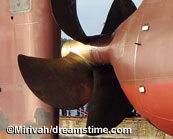
Figure 3-2: A boat propeller. A propeller is a type of fan. It is one way to make a boat move forward.
AC’s Boating Company
“Hey, Joe, we just got in the new propellers for the speedboats (see figure 3-2),” AC called out.
“Great,” replied Joe. “I think we should test them out so that we can tell our customers which will make the boats go fastest.”
“That is a good plan. I want to have them on the shelves for the weekend sale, though, so we need to get the tests done this afternoon,” AC stated.
“Well, I can go put the first propeller on test boat 1 and take it out on the water,” Joe said.
“That’s good. I was going to take all those heavy boxes over to the boat warehouse in my boat. I will put the second propeller on my boat and give it a try as I take the boxes,” AC replied.
Joe thought for a minute. “I think there’s supposed to be some really windy weather later this afternoon. If we really need to get the tests run, I can put the last propeller on the store’s test boat 2 now so that it will be ready when I get back. The water may be rough then, but at least I will have the propeller on and ready to go.”
Explain whether you think AC and Joe were being fair in the ways they tried to find the fastest propeller. List the reasons for your answer.
- Describe whether you would change anything about the tests AC and Joe did. If you would change anything, explain what you would change and why.
Activity Overview
In the Engage activity, Propelling You Forward, students will read a scenario about boat shop owners who want to test new propellers for their boats so that they can tell customers which propeller makes the boats go the fastest. Students will then determine whether the tests the shop owners are discussing are fair, and whether they should change anything about the tests.
Before You Teach
Background Information
Often, scientists want to understand how some factor or event influences another. They test that factor in an experiment. Engineers often do the same thing when they design solutions, but the intent of their experiments is to find the most positive outcome of the tests. For example, what can engineers change in the tests to maximize the speed of a boat or the height to which a rocket flies? Consumers also use tests, even though they are not involved in the official testing process. In Chapter 1, students acted as consumers to test which paper towel had the best design. The evidence from this “informal” test will help them, as consumers, to decide which paper towel they will purchase. Consumers may also use information from tests run by others, such as scientists at Consumer Reports magazine. Understanding testing and the variations on how it is used helps students as they design products, make decisions about purchases, and evaluate the work of others.
As You Teach
Outcomes and Indicators of Success
By the end of this activity, students will
-
begin thinking about the idea of fair tests.
They will show their thinking by
- deciding whether the boat shop owners in the scenario ran fair tests
- describing what they would change about the tests.
-
begin to relate the importance of testing to the work that engineers do.
They will show their thinking by describing why it is important for engineers to test products.
Strategies
Getting Started
Begin the chapter by directing students to the chapter organizer. They should read the key ideas, linking questions, and major concepts for the chapter. Then, have them read the introduction to the activity. Ask a few students to share how they tested the tool they built for Jason and Sam in the “Doing Technology” chapter. Ask a few others to share how they tested the paper towels in Chapter 1. Then pose the question in the introduction about what things would be important for engineers to think about as they conduct tests on a design.
Process and Procedure
In Step 1, students describe what they know about fair tests at this point. Because this is an Engage activity, accept all reasonable answers and do not correct students. Simply note what students currently think. Some students may feel that they do not have enough information about fair tests to answer the question. Encourage them to write what they think they know. If they are still resistant, you can have students break the phrase down and write what they think “fair” means and what they think “test” means.
Have students read the scenario about a fictitious boat shop. You may wish to have students role-play the characters in the scenario. Make sure students look at figure 3-2 if they are not familiar with propellers.
Give students a few minutes to describe whether they think the characters in the scenario were being fair. Students should list the reasons for their answers. You may need to emphasize that they should write down their best ideas if they are not sure about their answers. Again, do not correct students at this stage in the 5E Instructional Model.
- If students have a grasp of what constitutes a fair test, they may have ideas about what the boat shop owners should change in the tests. This is an opportunity for them to describe those changes. It also gives you an idea about what they know about fair tests and how to conduct them.