



Work with your team to answer the following questions. Be sure to record your ideas in your technology notebook.
-
Why do you think the third column of Alex’s table is called “preliminary decisions”?
-
The engineers came up with a list of criteria, constraints, and decisions. Do you think other engineers would use an identical table? Explain your answer.
-
Choose one of the following items that you might find in a middle school. Then, complete Questions 3a–3f for the item you chose:
 Figure 1-11: An example of a lunch tray that does not require a plate. What criteria and constraints will you have in designing a tray similar to this one?
- A trash can
- A locker
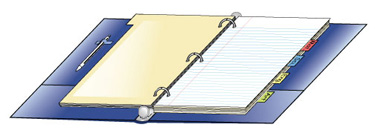
- A notebook (See figure 1-10.)
- A lunch tray that does not require a plate (See figure 1-11.)
- Draw a three-column table in your technology notebook. Write the name of your item at the top of the table. Add the headings “criteria,” “constraints,” and “decisions.”
- In the first column, list the criteria that the engineers might have decided on for the item.
- In the second column, list the constraints that the engineers might have had to work around.
- In the third column, list the decisions that the engineers might have made as they designed the item.
- Do you think your table has the same criteria, constraints, and decisions compared to the tables of other classmates working on the same object? Why or why not?
- How does your item change human limits? In other words, how does it match the definition of technology?
-
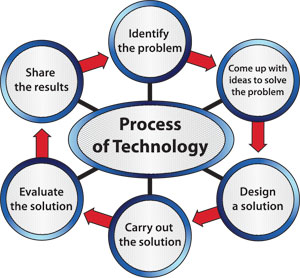
Look back at the graphic from The Process of Technology Design master that you put in your technology notebook during the Explore activity.
- With a different-colored pen or pencil, write down one or more Xs to indicate which stage or stages Mario, Camille, Alex, and Sonya’s work would fit into. You should use a color that you have not yet used on this graphic.
- Write “Explain” next to the X.
- Explain in writing why you chose the stage you did.
Answers to Reflect and Connect
Students should work in their teams to answer the questions. Make sure all students record their own answers in their technology notebooks. You may also wish to have a class discussion about some or all of the questions.
-
Why do you think the third column of Alex’s table is called “preliminary decisions”?
You may need to help students understand the word “preliminary.” This question emphasizes that engineers make decisions about designs before they begin to make the product, but sometimes they need to adjust those decisions. Students may have discovered this as they designed the tool for Sam. For example, they might have thought they could attach a part a particular way but found that it was not possible or that the tool did not work using their original decisions.
-
The engineers came up with a list of criteria, constraints, and decisions. Do you think other engineers would use an identical table? Explain your answer.
Students should begin to realize that some engineers may place more value on some properties whereas other engineers may place a different value. Another group of engineers may believe that the size of the paper towels or a low cost is the most important property. Engineers always have to judge what they think consumers will value and make their designs accordingly. You might point out that companies sometimes target brands for particular consumers. For example, a company might make one brand that is inexpensive but low quality. The same company might also sell another brand that is strong, soft, and absorbent but more expensive.
-
Choose one of the following items that you might find in a middle school. Then, complete Questions 3a–3f for the item you chose:
- A trash can
- A locker
- A notebook (See figure 1-10.)
- A lunch tray that does not require a plate (See figure 1-11.)
- Draw a three-column table in your technology notebook. Write the name of your item at the top of the table. Add the headings “criteria,” “constraints,” and “decisions.”
- In the first column, list the criteria that the engineers might have decided on for the item.
- In the second column, list the constraints that the engineers might have had to work around.
- In the third column, list the decisions that the engineers might have made as they designed the item.
- Do you think your table has the same criteria, constraints, and decisions compared to the tables of other classmates working on the same object? Why or why not?
- How does your item change human limits? In other words, how does it match the definition of technology?
You can allow students to select their own item or you can assign items to them. Students should list reasonable criteria and constraints for the item. The table in figure T1-2 provides sample responses, but you should accept any reasonable answer. For Question 3e, students should realize that other students might have different criteria and constraints. This question prepares students to think about the ideas that different objects have different criteria and constraints and that different people have different ideas about what is valued. Question 3f assesses whether students understand the definition of technology. A trash can extends human limits because it allows us to collect trash in one place rather than gather it from many places. A locker extends human limits because it allows students to keep their belongings in one place rather than carry everything at all times. A notebook extends human limits because it allows people to keep materials organized and in one place. A lunch tray that does not require a plate extends human limits because it helps people carry food without juggling many plates. Use students’ answers to this step as a formative assessment to make sure they understand criteria and constraints.
-
Refer to The Process of Technology Design graphic that you put in your technology notebook during the Explore activity.
- With a different-colored pen or pencil, write down one or more Xs to indicate which stage or stages Mario, Camille, Alex, and Sonya’s work would fit into. You should use a color that you have not yet used on this graphic.
- Write “Explain” next to the X.
- Explain in writing why you chose the stage you did.
Students should realize that the engineers were in the stage of coming up with ideas to solve the problem. They were brainstorming about different criteria and constraints that would go into the problem.