








You have now done an investigation to rank paper towels based on one property that you chose. What if you wanted the best paper towel overall? Do you think you would be able to do all the tests you would need to do?
Think about other products you might want to buy, like a water bottle. It might get expensive to test all the different water bottles to find the best one. What if you wanted a new bicycle? How do you think you would run tests on different bicycles?
In this Explain activity, Paper Towel Consumers, you will find out more about tests other people have run on paper towels. Using information from other people can provide you with evidence to make a good decision. Materials
-
Look back at the list of tests your class ran for the paper towels.
- Are there any properties that you would like to know about that were not tested?
- How do you think consumers could find out about properties for a product they wanted to buy?
-
Read Need to Know: Consumer Reports to help you understand more about what you will do in Step 3 of this Process and Procedure section.
Need to Know: Consumer Reports
In 1935, advertising became more popular. People started seeing ads for products everywhere. Many of the ads claimed that a product was the best available. At the same time, a group of people thought consumers did not have access to good information about products. This group included professors, journalists, and engineers. The group wanted consumers to have a reliable, fair source of information that would tell them which products tested as the best. The group also wanted to provide information about products that did not rank highly. The group began an organization called the Consumers Union. The organization began testing products for consumers.
The results of the tests were published in a magazine called Consumer Reports. The group still publishes the magazine today. It is one of the top-10 best-selling magazines in the United States. It is important to Consumers Union to stay fair and independent. For that reason, it does not accept advertising or free samples of products.
-
With your team, look at the ratings table in figure 1-4. Answer the following questions about the information in the table. Record your answers in your technology notebook.
- What properties did the Consumer Reports investigators test?
- Why do you think the investigators chose those properties?
- How does the Consumer Reports list of properties compare to the list you tested?
-
Watch the video to see how Consumer Reports investigators tested the products.
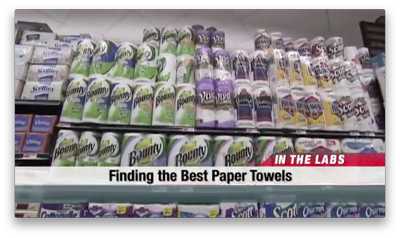 Play Video
© Copyright 2009 by Consumers Union of U.S., Inc. Yonkers, NY 10703-1057, a nonprofit organization.
Play Video
© Copyright 2009 by Consumers Union of U.S., Inc. Yonkers, NY 10703-1057, a nonprofit organization.
Reprinted with permission from the December 2009 issue of Consumer Reports for educational purposes only. No commercial use or reproduction permitted. www.ConsumerReports.org. -
Practice reading the ratings table in figure 1-4 by choosing one brand of paper towel and explaining the results to your team. Each teammate should have a chance to explain the results for one brand. Hint
-
Answer the following questions about the paper towels. You may discuss the answers with your team. All teammates should record their answers their technology notebooks.
- Which brand has the longest roll?
- Which brand is the most expensive?
- Which brand has the highest absorbency?
- Which brand do you think is best overall?
- What is your evidence for the answer you chose in Step 6d?
-
So far in this chapter, you have thought a lot about how consumers look at products that are already made. Do you think engineers who design paper towels should be concerned with any of the properties you have explored? Why or why not?
-
Read One Morning at Work to learn more about why engineers think about the properties of a product. Take on the roles of the different engineers and narrators. Read your lines aloud. As you read, add any bold or unfamiliar words to your personal glossary. Hint
-
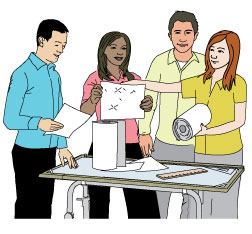
Figure 1-5: These young engineers are hard at work. They are trying to design a new brand of paper towel. How will they decide which properties the paper towels need?
One Morning at Work
NARRATOR 1: Scene: An office in San Francisco, California. In the office are drawing supplies, paper, drafting boards, and samples of paper towels. (See figure 1-5.) Four young engineers are starting to design a new brand of paper towel.
MARIO: I want to make sure these paper towels sell. This brand should be the best at everything.
CAMILLE: It cannot be the best at everything. We need to narrow it down.
ALEX: Yes, if we narrow it down to being the best at some things, we can make a better towel.
SONYA: Okay, then let’s set some goals for our towels. What do we want our paper towels to be?
CAMILLE: The strongest!
ALEX: The most attractive on the shelf!
MARIO: The most absorbent!
SONYA: The most convenient!
ALEX: Hang on—I am writing all of this down. I am going to make a table for our goals.
SONYA: Okay, any others?
CAMILLE: That seems like the basics.
SONYA: Are there any goals here that we do not think are possible?
MARIO: They all look good, but we need to know more about each one. That will make a difference in how we reach our goals.
ALEX: Like what?
MARIO: Well, for starters, when people say they want a stronger paper towel, what does that mean? What are they going to use a paper towel for that it needs to be so strong? I mean, who needs a strong paper towel just to dry their hands?
ALEX: People use paper towels for other things besides drying their hands. I use them for cleaning.
SONYA: So? I don’t need a paper towel to be strong to wipe smudges off a mirror.
ALEX: No, people use them for more than that. These days, people expect paper towels to be like sponges. They use cleaner and a paper towel to clean their kitchen sinks.
CAMILLE: Great. We will make a towel so strong that it doesn’t get holes or shred when you scrub with a cleaner.
MARIO: Okay, then what about attractive? What do people find attractive?
SONYA: I think we should stick with colors and patterns that go with things in most kitchens—maybe blue, green, pink, and brown.
CAMILLE: Let’s stick with nature patterns. I like flowers and leaves and trees.
ALEX: Good idea. I am going to make a new column beside my “goals” column for these suggestions.
CAMILLE: Let’s call it “things that limit the design.”
ALEX: Sounds good. Take a look at this. (See figure 1-6.)
Figure 1-6: Alex’s table. Alex has added “goals” to his table. He has also added “things that limit the design.”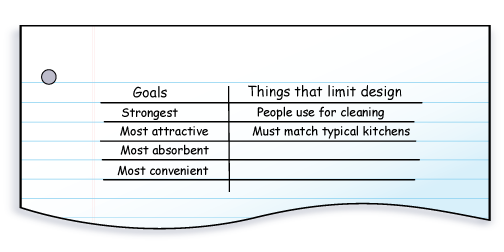
MARIO: At my house, most spills happen at the dinner table. Someone spills a drink and everyone bolts for the paper towels.
ALEX: Yeah, but you end up using about 10 paper towels.
SONYA: Alex, write down that the average spill is a full glass.
CAMILLE: A full glass is about 8 ounces. Add that to the list, too.
MARIO: What about “most convenient”? What does that mean?
-
Figure 1-7: This roll of paper towels does not fit in the holder. How does this relate to convenience?
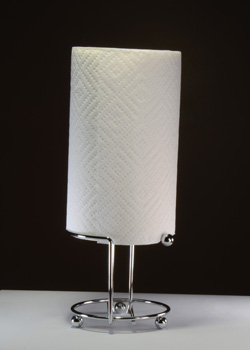
SONYA: Well, one time we bought a roll of paper towels that did not fit into our paper towel holder. The roll was too fat to fit into our holder on the counter. (See figure 1-7.) We just left the roll on the counter. Once, I accidentally knocked the roll into the sink and ruined half the roll.
CAMILLE: Another thing that bothers me is when you are racing to wipe up a spill. You give a good yank, and half the roll comes with you.
ALEX: Or when the towel tears somewhere in the middle instead of at the perforation.
MARIO: Okay, then put “size of holder” and “strength of tug.”
SONYA: You know, I think we might be getting carried away. We don’t want to have to use too many expensive materials to make these great towels we are designing. We can design all we want, but it won’t do us any good if the Manufacturing Department says we don’t have enough money.
CAMILLE: Well, that limits our goals, too. We are limited in the materials we can afford to buy. Alex, write “materials” in the list of things that limit the design.
MARIO: So what people want has a significant effect on the goals, but other things do too. I never would have thought of that.
ALEX: Something is still missing from my list. We haven’t said exactly what our paper towels will do.
CAMILLE: Sure we have! You just didn’t write it down. For “strongest,” we said that when people use the paper towels with cleaner, they won’t develop holes or shred apart.
SONYA: But how do we do that?
CAMILLE: Let’s weave nylon thread into each towel.
ALEX: I will make another column. (See figure 1-8.) I think a good heading would be “preliminary decisions.” On the “strongest” line, I will write, “Weave enough nylon thread into each towel so it will not tear when you use cleaner.”
Figure 1-8: Alex’s final table. By the end of the discussion, Alex had created columns for “goals,” “things that limit the design,” and “preliminary decisions.”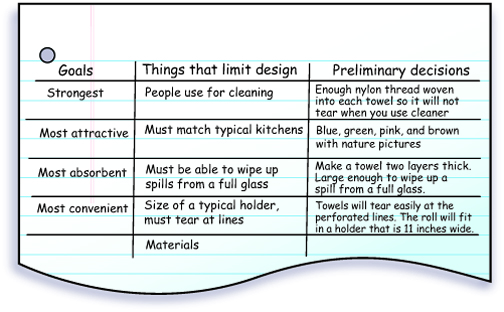
MARIO: For “absorbent,” how about, “Make the towel two layers thick. Make it large enough to wipe up a spill from a full glass.”
SONYA: On the “attractive” line, put, “Decorate it with blue, green, pink, and brown and with nature pictures.”
CAMILLE: And on the “convenient” line, write, “Towels will tear easily at the perforated lines. The roll will be 11 inches wide.”
ALEX: How do you know that, Camille?
CAMILLE: I just measured this roll of paper towels on my desk. Okay everyone, that is it for the day. I will take this design down to Manufacturing to see what they say. Then they can get started on the perfect paper towel.
NARRATOR 1: As engineers, Mario, Camille, Alex, and Sonya are right on target. By getting together and listening to one another, they have pointed out important ideas about design. You need to understand these ideas as well.
Consumers judge a product by whether it meets their criteria. For example, what would happen if the engineers made a towel that people did not find attractive? The engineers would have failed to meet the “attractive” criterion. Consumers might be less likely to buy the new paper towels. Setting criteria is the first step in deciding on a design. Designers have to think about which criteria consumers want.
NARRATOR 3: The engineers listed limits to the design in the table’s second column. Consumers have preferences about the products they buy. Sometimes people have physical or mental limits that affect their criteria for a product. This means that human factors play a role in determining how designers make products. Taking into account human factors allows them to design a product that will help consumers solve problems. The engineers can make products that will be easy for consumers to use.
As Mario pointed out, other things affect how designers meet their criteria. These other things then affect the final decisions about a product. Most often these other things have to do with the amount of money available or how much profit can be made. They also have to do with the materials that are available or affordable.
Human factors and other things that affect goals are called constraints. If designers tried to make decisions based only on criteria, they would probably not be able to make the best product. For example, they might be able to create a paper towel that can absorb all spills and never fall apart. However, that roll of paper towels might cost $15. Determining constraints is the next step in designing a product.
NARRATOR 4: Once you have thought about all the criteria and constraints, you can begin making decisions about the product. This is the last step in product design. Once you have gone through these steps, you are more likely to make a product consumers will be able to use easily. Using the information you have learned here, Alex could revise his table to look like the table in figure 1-9.
Figure 1-9: Revisions to Alex’s table. You learned words such as criteria and constraint in this reading. Alex could revise his table to use these words.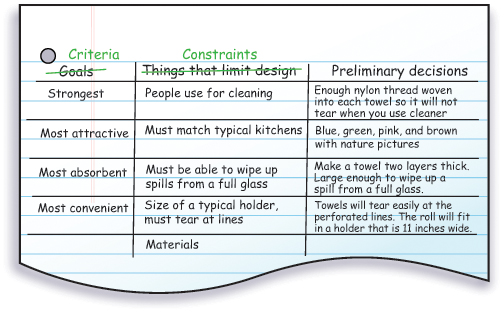
-
-
Read back through Jason’s Little Brother in How Do I Do Technology?, the Explore activity of “Doing Technology.” Then create a table like the one in figure 1-9. Use the headings “criteria,” “constraints,” and “preliminary decisions.” Then complete the table with the criteria, constraints, and decisions you made when you designed the tool for Jason’s brother Sam. Hint
-
Share the information in the table with your team. Make any necessary revisions using a different-colored pen or pencil.
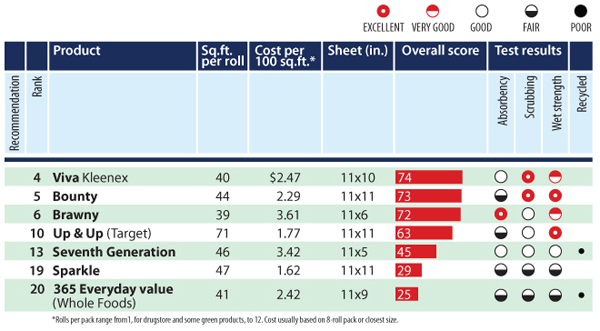
Data Source: Copyright 2009 by Consumers Union of U.S., Inc. Yonkers, NY 10703-1057, a nonprofit organization. Reprinted with permission from the December 2009 issue of Consumer Reports for educational purposes only. No commercial use or reproduction permitted. www.ConsumerReports.org.
Activity Overview
In this Explain activity, Paper Towel Consumers, students will first practice reading a data table from Consumer Reports to understand how they might obtain information about which products to buy. Then, they will role-play based on a reading that shows the work of four engineers. As they read, they will learn about how engineers use some of the same ideas in their work that consumers use when they buy products. Students will find out about criteria, constraints, and preliminary decisions.
Before You Teach
Materials
For the entire class:
- pens or pencils of different colors
- 1 copy of Consumer Reports magazine (optional)
Advance Preparation
During this activity, students interpret a data table from Consumer Reports magazine. If you have access to a copy of this magazine, it might be helpful to bring it to class. Doing so will reinforce to students that it is an actual magazine with information about many different products. This is optional, as you will not need a copy of the magazine to complete any steps.
As You Teach
Outcomes and Indicators of Success
By the end of this activity, students will
-
understand how consumers can evaluate products.
They will show their understanding by
- answering questions about an investigation from Consumer Reports
- determining information based on a data table.
-
be able to explain criteria and constraints.
They will show their understanding by
- describing the criteria and constraints they worked with when designing a product
- describing the criteria and constraints they think others worked with in designing products.
-
describe how engineers use criteria and constraints.
They will show their ability by
- role-playing a scenario about engineers’ work
- describing the criteria and constraints engineers had to consider when designing products.
-
be able to interpret data from a data table.
They will show their ability by answering questions based on information from a data table.
Strategies
Getting Started
Have students look at the chapter organizer. They should see the linking question that helps them make the connection between the Explore activity and this activity, although they will not be able to answer the question until they complete this activity. They should also see the key idea of this activity. Remind them that in the Explore activity, they tested paper towels for a property they chose. Then, ask what they would do if they were buying something more expensive. Would they be able to test all the different brands they could buy? Have them read the introduction as they keep this question in mind.
Process and Procedure
-
Have students refer to the class data table from Step 11 of the Explore activity. Ask them to think about what properties the class did not test. They should consider properties that might not be testable, such as cost and length of roll. Give them a few minutes to answer Steps 1a–1b.
-
Students should read Need to Know: Consumer Reports. This provides brief information about the source of the ratings table that they will use later in the activity. If you have a copy of Consumer Reports magazine, show it to students to help reinforce that this is an actual magazine.
-
Give students enough time to work with their teams and answer the questions. Note that they will read information from the table in Steps 5 and 6, so limit the amount of questioning you do at this point about the highest-ranked or most expensive paper towels.
-
Step 4 links to an interesting video about how the staff at Consumer Reports carried out their tests on paper towels. After watching this video, students might realize that their tests are similar to the tests conducted by professional investigators.
-
Have students work in their teams of 3 to practice reading the ratings table. Each team member should choose one brand of paper towel and explain all the results for that brand to their teammates. This step offers individual accountability, in a low-stakes manner, for reading the table. Students who are confident about reading the table will volunteer to go first, whereas students who are less confident will volunteer to go after they have heard their teammates share information.
-
Students will answer questions using information they can obtain from the ratings table. This gives them practice at reading a table.
- Make sure students understand that they have been thinking from a consumer’s point of view so far in this chapter. This program focuses on engineering, or doing technology, however. Step 7 helps students make the connection between consumers and engineers. Students should answer the question about whether engineers should be concerned with the properties that students explored. At this point, students should be writing down their best ideas. Do not expect them to have a correct answer. This question serves as a pre-reading strategy before students read more about what engineers have to consider in their work.
-
Read the reading One Morning at Work aloud. Assign students roles to read for the parts of four engineers—Mario, Camille, Alex, and Sonya—and the parts of four narrators. As they read, students should add any bold or unfamiliar words to the personal glossary that they started in the Doing Technology chapter. If students need more help setting up their personal glossaries, you might take a few minutes to look at How to Develop a Personal Glossary before beginning the reading. Remember that How To documents provide general information about a strategy and are not related to the content of an activity. Adding words to their personal glossaries is a during-reading strategy. At a minimum, students should add “criteria,” “constraints,” and “human factors” to their glossaries.
-
Step 9 is a post-reading strategy to make sure students understand the concepts of criteria, constraints, and preliminary decisions. Have students read through Jason’s Little Brother from the Explore activity (How Do I Do Technology?) in the “Doing Technology” chapter. Then, ask them to create their three-column tables. The hint will help students understand where they might look in Jason’s Little Brother to get started. Students should first fill in the criteria and constraints that Jason has for the tool. Some criteria are that the tool must help Sam turn the light on and off, be removable, and last for several tries. Some constraints are Sam’s height, Sam’s lack of coordination, and that the tool must be safe, with no small parts. Students should then fill in the decisions they made based on the criteria and constraints. For example, they might say they made the tool a certain length or padded it with a particular material.
-
Allow students time to share their tables with their teams of 3. They should revise their tables based on the discussion. Revisions are a metacognitive strategy that helps students reflect on their learning. They also help reinforce that science and engineering are areas in which answers may sometimes be tentative. As engineers obtain more information, they are able to revise their ideas.