






Photo by Stephen Ausmus
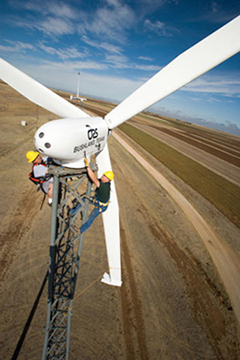
Since you were little, people have been telling you things to do to stay safe. Do you think it is important to consider safety when you do technology? You have learned about the process of technology design. Safety was mentioned in more than one stage. It is important that you and others stay safe while you are doing technology. It is also important for people who work as engineers to stay safe, as shown in figure 16. Their solutions also have to keep other people safe. In this Elaborate activity, you will learn more about how you can stay safe as you do technology. Materials
-
Prepare your technology notebook for a new activity. Then, read the following paragraph to help you understand what you will be doing in this activity.
You and your class have decided to start a new company. You are interested in making small plastic toys. The toys will be shaped like different animals. Because your company will be starting out small, you will not have many machines. This means that people will be in charge of several of the steps for making the toys. Your company’s first step is to decide what safety equipment it should order for each job. Your team will look at the safety equipment for one job. Production of the toys cannot begin until each job has the right safety equipment.
-
Obtain a set of 4 job description cards for your team from your teacher. Read the description on your own.
-
Discuss your job with your teammates. Make sure that each student on your team understands the job. Hint
-
Another company has provided you with its catalog of safety equipment. Work by yourself to read the description of each piece of equipment in the Safety Equipment Catalog master. Make a list of each piece of equipment you think you need for your job. Hint
-
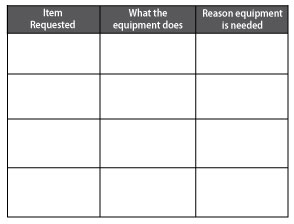
Hold a discussion with the other students on your team about your choices for safety equipment. Your teammates should all have the same job as you. Create a table on the large sheet of paper that shows the final list of equipment your team is requesting. Hint
-
Prepare to present your request list to the president of the company and other workers (your teacher and the class). Be ready to explain your job. Also, explain why people working on the job need each item your team listed.
-
Present your list and explanation for each item to the class. Listen as other teams present their lists. Participate in a brief discussion about each presentation. Hint
-
In this activity, you have been thinking about your own safety as you do your job. Your company is also concerned about the safety of the children who will play with the toys.
Study the plastic toy animals your teacher shows you. Then, read the table in figure 18 to learn about the “safe-to-use” checklist.
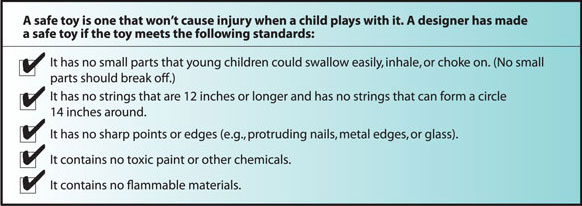 Figure 18: “Safe-to-use” checklist. Use this checklist as you think about safety concerns for the toys.
 -
Create a two-column table. Label the first column “Safety concern.” Label the second column “Solution.”
-
Work with your team to come up with a list of all the safety concerns or risks you can think of. These should be risks to someone playing with the toys. List them in the first column of your table. Hint
-
For each safety concern in the first column, think of at least one idea of how you could limit the risk. Write down your ideas in the second column next to the risks they go with.
-
Share your ideas in a class discussion. Be ready to discuss one safety concern and your idea of how to limit the risk for that concern.
Activity Overview
Safety is an important issue when we think about doing technology. In this Elaborate activity, students will take on the roles of employees at a new toy company. They will need to determine the safety equipment necessary for the different jobs within the company. Additionally, they will think about the safety concerns that might affect consumers of the product they design.
Before You Teach
Materials
For each class of 30 students:
- 8 to 9 large sheets of paper
- markers
- 4 copies of 1 job description from the Job Descriptions master for each team of four students
- 30 copies of Master DT-4, Safety Equipment Catalog (optional; you may also provide one copy per team of four students)
- plastic toy animals
Advance Preparation
The job descriptions are on Master DT-3, Job Descriptions There are four different jobs on the master. For a class of 30 students, make eight to nine copies of the master. Cut apart the job descriptions. Each team of four students will have the same job, so each team should get four copies of the same job description. Most classes will have more than one team with the same job description. Decide if you would like to make copies of Master DT-4, Safety Equipment Catalog. It appears as a reference for Step 4. If you are projecting the steps, it may be easier to make copies of the catalog for each student or each team.
If you are able, bring in a few plastic toy animals to show students in Step 8. If you are unable to bring any, find some pictures of plastic toy animals on the Internet.
As You Teach
Outcomes and Indicators of Success
By the end of this activity, students will
-
understand the importance of using safety equipment when they are doing technology.
They will show their understanding by
- developing a list of safety equipment needed for their “jobs” in a toy factory
- describing something they do in their middle school classes that requires safety equipment.
-
analyze the risks designers must consider when developing solutions to problems.
They will show their thinking by
- brainstorming about the safety considerations related to consumers of the toys made at their jobs
- identifying appropriate solutions to safety concerns
- deciding whether engineers can eliminate all risks from their products.
-
reflect on the phases of the BSCS 5E Instructional Model.
They will show their reflection by describing what they did in the activity that matches the goals of an Elaborate activity.
Strategies
Getting Started
Have students look at the chapter organizer and find where they are in their learning pathway. Have them read the introduction to the activity. Hold a brief class discussion about what students do in their everyday lives to help keep them safe. Then, talk about what people who do technology might have to consider with regard to safety. First, students should bring up ideas that relate to keeping the person who is doing technology safe. Second, they should consider ideas that relate to keeping the people who use technology safe. Be sure both types of ideas are part of the discussion.
Process and Procedure
-
Begin by having a student read aloud the paragraph describing a scenario where the class has decided to start a new company. Use your judgment about whether students need more of an explanation. The important points of the paragraph are that they are starting a new company similar to the LEGO Group. The LEGO Group uses a lot of machinery in its factories, but because the students’ company is new, it will not have many machines. This means people will be doing many of the jobs that machines might do at bigger companies. The students will work on a team with other students who have the same job. The team must decide which safety equipment is needed to help keep them safe in their jobs.
-
As you begin Step 2, divide the students into teams of four. Because students have been working in pairs in the previous activities, the easiest way to do this is to have two pairs join. Hand out the job descriptions. Each student on a team of four should have the same job description. Students will become experts on the safety equipment needed for that job. If your class has more than 16 students, more than one team will have the same job description. This will allow you to hold discussions between the teams about their choices in later steps.
-
Have students talk about the team’s job in Step 3. Students should make sure that all members of the team understand the job. Be sure to read the hint. Throughout the program, teamwork skills are listed. Remind students that working well on a team takes practice. Hold a brief discussion with them about the question in the hint and how they can ensure that all of their teammates understand the team’s job. Team members might ask each other questions about the job, or explain the job in their words.
-
In Step 4, have students read the Safety Equipment Catalog master. They should initially work by themselves to list the equipment that they think they need. You may want them to make notes about why they think they need each piece of equipment. Be sure to have them read the hint. It is important that they realize that the company wants to order all of the equipment it needs to stay safe, but it does not have the money to order unnecessary equipment. For this reason, they should carefully consider what equipment they need for the job.
-
Once students have had enough time to make their individual lists, they should begin Step 5 by talking with their teammates about the lists. Be sure to have them read the hint. Students may add additional equipment not listed in the Safety Equipment Catalog if they think it is necessary, but remind them that they are trying to keep themselves safe without spending money unnecessarily. The team should finish the list and include it in a table on a large sheet of paper.
-
Make sure students take the time to prepare their brief presentations for the president of the company (you) and other workers (the class). They should be able to describe each piece of equipment that they want for the job. They should also be able to tell why the job requires each piece of equipment they listed. This is when they should decide who will say what in the presentation as well as ensure that each teammate understands the team’s reasoning. You may want to require that each teammate says something in the presentation, so students should be aware of this requirement during this preparation time.
-
Have each team make a presentation to the president and the rest of the company. If you have more than one team with the same job description, have those teams present one after the other. Then, hold a brief discussion about each job’s equipment. Step 7 lists questions for students to think about during the presentations and for you to discuss.
Items that students should strongly consider for each job:
- Plastic melter: Heat protection gloves, goggles, heat protection suit, face respirator, chemical spill kit, first aid kit
- Dyer: Heat protection gloves, goggles, heat protection suit, face respirator, chemical spill kit, first aid kit
- Mold pourer: Heat protection gloves, goggles, heat protection suit, face respirator, chemical spill kit, first aid kit
- Packager: Hard hat, forklift, first aid kit, steel-toed boots.
-
As you begin Step 8, tell students that people who design technology must also think about the safety of the people who will use their products. Show students some plastic toy animals. Then, have them read the table showing the “safe-to-use” checklist. Remind them that this checklist is for final products, but they need to think about the steps involved in making the toy. What will they need to consider as they are producing toys?
-
Have students draw the table in their technology notebooks.
-
Give teams time to work on the task in Step 10. Encourage students to come up with as many reasonable safety concerns as they can. For example, they should think about whether the size of the toys poses a choking hazard, and whether the dyes and plastics are toxic. Remind them of the “safe-to-use” checklist and how it might apply to them as they design the toys.
-
In Step 11, students should think about how to limit the risk of each concern from Step 10. They might have some trouble coming up with a solution. Tell them that it is okay not to have a perfect solution for every concern and that they should come up with their best ideas.
-
In Step 12, hold a class discussion about the safety concerns that students listed. Talk about whether they were able to think of the perfect solution for all risks. For example, they may have thought of the idea of using only nontoxic dyes and plastics. On the other hand, if they thought of making the toys big enough to not pose a choking hazard, that might change the design so much that the toys no longer appeal to older children. The company might not want to make this change.